

 Quality Lab Equipment Manufacturer & Supplier
Lab Equipment
Material Testing
Suppliers India
Manufacturers
Fluid mechanics labs have one weakness that other labs do not: they depend on water. A rig with a cracked sump, a pump that has scaled up, or a manometer full of air bubbles gives readings no student can trust. Most failed fluid labs fail on services and upkeep, not on the choice of apparatus.
Naugra Lab Equipments manufactures and supplies fluid mechanics and hydraulics teaching equipment from Ambala Cantt, Haryana, India. We supply engineering colleges, polytechnics, TVET institutions and project contractors across Africa.
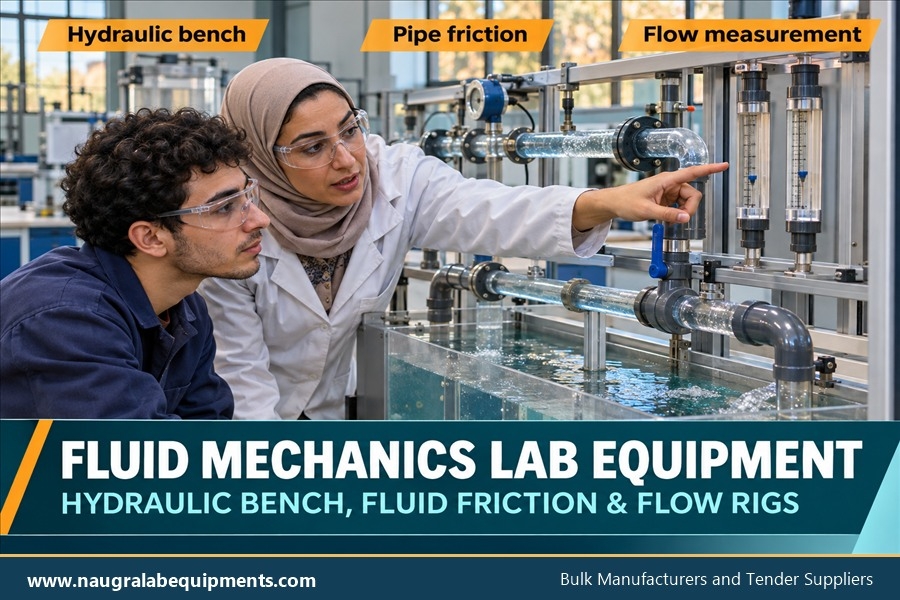
A hydraulic bench is a mobile tank with a pump, a flow control valve and a volumetric measuring tank. It supplies water to small experiment modules placed on its top and measures the flow by timing the rise in the measuring tank. One bench can serve many experiments, which makes it the core of a teaching lab. See the Engineering Hydraulic Bench and Accessories, the Hydraulics Bench and the accessories for the hydraulic bench.
How many benches? Each experiment needs a group of four or five students for about an hour. A class of 40 working in eight groups needs either eight benches with one module each, or fewer benches and a rota across the term. Most colleges choose four to six benches and a full set of modules.
| Experiment | Learning point | Apparatus | Runs on |
|---|---|---|---|
| Bernoulli's theorem | Pressure and velocity along a converging duct | Bernoulli apparatus | Bench |
| Reynolds experiment | Laminar and turbulent flow | Reynolds Apparatus | Bench or own tank |
| Flow measurement | Coefficients of discharge | Venturimeter, orificemeter, rotameter | Bench or own rig |
| Orifices and notches | Discharge through openings and over weirs | Orifice and Mouthpiece Apparatus, Flow Over Notches Apparatus | Bench |
| Impact of a jet | Force from momentum change | Impact of Jet Apparatus | Bench |
| Hydrostatics and stability | Centre of pressure; metacentric height | Metacentric Height Apparatus, hydrostatic pressure set | Bench or stand-alone |
| Vortex flow | Free and forced vortices | Forced Vortex Flow | Bench |
| Pipe friction | Friction factor against Reynolds number | Losses in Pipe Friction Apparatus, Fluid Friction Measurement | Own rig with tank and pump |
| Losses in fittings | Bends, valves, expansions | Losses in Pipe Fitting Apparatus | Own rig |
| Pipe networks and surge | Flow sharing; water hammer | Pipe Network Apparatus, Pipe Surge and Water Hammer Apparatus | Own rig |
| Open channel flow | Hydraulic jump, weirs, flow under gates | tilting flume | Own floor space and sump |
See fluid mechanics lab equipment, flow in pipes and flow channels.
Hydraulic machines are usually taught in a separate bay because the rigs are large and need three-phase power. A typical set has a centrifugal pump test rig, a reciprocating pump rig, a Gear Pump Test Rig or Multi Pump Test Rig, and the three turbine types: Pelton wheel, Francis and Kaplan. A Cavitation Demonstration unit is worth adding. See fluid machines and hydraulic machine lab. For air flow, a Wind Tunnel or Compressible Flow Bench belongs in a separate aerodynamics lab.
Tenders for fluid labs work best when they list experiments as well as apparatus, and ask bidders to show which bench each module fits. Modules from different makers rarely fit each other's benches, so buy bench and modules together.
Contractors should include a commissioning visit: filling, priming, checking every manometer and running one experiment of each type with the instructors. Distributors can hold spares such as manometer tubing, valves, seals and pump impellers for the colleges they serve.
Related posts: STEM lab equipment list for engineering colleges, Mechanical Engineering Lab Equipment and civil engineering lab equipment for colleges.
A mobile water tank with a pump, flow valve and volumetric measuring tank. It feeds small experiment modules on its top and measures their flow rate.
Bernoulli's theorem, orifices and notches, impact of a jet, flow meters, vortex flow and some hydrostatics experiments. Pipe friction, networks and flumes usually need their own rigs.
Most colleges use four to six benches with a full set of modules, and rotate groups through the experiments during the term.
Avoid it. Water manometers or digital pressure gauges are safer, and many countries now restrict mercury.
Larger rigs usually do. Tell us your supply and we will state the motor rating for each rig.
Send the experiment list, class size and the power supply in your lab. Write to sales@naugralabequipments.com or send the details through our contact page.
Talk to our specialists about your laboratory setup or bulk-tender requirements.
