

 Lab Equipment Exporter Across Africa
Material Testing
Precision Instruments
Engineering Lab
Worldwide Export
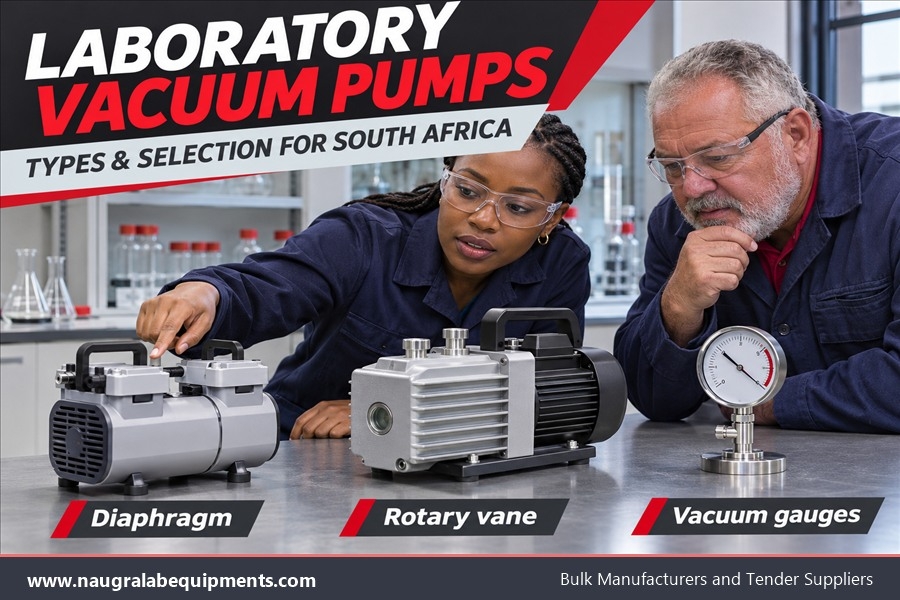
Most laboratory vacuum pumps are bought for one job and then used for every job. A pump chosen for gentle filtration ends up on a rotary evaporator pulling solvent vapour through its oil. Within months the oil is milky, the vacuum is poor and the pump needs a rebuild. Choosing the pump for its real duties avoids that.
Naugra Lab Equipments manufactures and supplies laboratory vacuum pumps and general lab equipment from Ambala Cantt, Haryana, India. We supply universities, laboratories and distributors in South Africa and across the continent.
| Type | How it works | Strengths | Limits |
|---|---|---|---|
| Oil-sealed rotary vane | Vanes sweep gas round an oil-sealed chamber | Deep vacuum; good for drying ovens and freeze drying | Oil must be changed; solvent and acid vapour damage it; needs an exhaust mist filter |
| Oil-free (diaphragm or piston) | A flexing diaphragm or dry piston moves gas | No oil to change or contaminate; handles vapour better with the right materials | Lower ultimate vacuum than oil-sealed pumps |
| Water jet aspirator | Water flowing through a nozzle draws air | Cheap; simple for school filtration | Uses a lot of water; vacuum depends on water pressure; waste water carries vapours |
Our range includes the Naugra Lab Vacuum Pump, the Naugra Lab Vacuum Pump (Oil Free) and a vacuum pump motor. See laboratory vacuum pumps.
| Application | Vacuum needed | Suggested type |
|---|---|---|
| Filtration with a Buchner flask | Low to medium | Oil-free, or aspirator for schools |
| Vacuum desiccators | Medium | Oil-free |
| Rotary evaporation of solvents | Medium, controlled | Oil-free with chemical-resistant parts and a cold trap |
| Vacuum oven drying | Medium to high | Oil-sealed with a trap, or oil-free for solvent-laden samples |
| Degassing, freeze drying, physics demonstrations such as the Bell in Vacuum | High | Oil-sealed rotary vane |
Run oil-sealed pumps warm for a few minutes before and after solvent work, using the gas ballast if fitted, so vapour does not condense in the oil. Change oil when it darkens or clouds. Keep a log of hours and oil changes. For oil-free pumps, replace diaphragms and valves on the maker's schedule and keep a spare kit. Never let liquid reach the pump: a cheap catch pot saves an expensive repair.
South African mains is 230 V at 50 Hz single phase and 400 V three phase. Sockets are type M, with the newer type N in many buildings, so specify the plug or supply pumps with a flying lead for local fitting.
Electrical equipment for measurement, control and laboratory use falls under the compulsory specification for electrical and electronic apparatus, VC 8055, which refers to SANS 61010. Products in scope need a Letter of Authority (LoA) from the National Regulator for Compulsory Specifications (NRCS) before sale. The applicant must be a South African legal entity, so the local importer or distributor normally holds it. Check with the NRCS or a compliance consultant which of your pump models are in scope, and allow time for testing and approval before the first shipment.
Sea freight from India usually lands at Durban, with Cape Town and Ngqura or Gqeberha as alternatives. Confirm duties and any permits with your clearing agent.
Distributors: stock two or three pump models that cover filtration, rotary evaporation and drying, rather than one model for everything. Hold spare oil, diaphragms, valves and exhaust filters. If you hold the LoA, keep the approved models stable; a change of model may need a new approval. Pumps can be supplied under your own brand; see OEM and contract manufacturing.
Universities and project buyers: list each lab's applications in the tender and ask bidders to propose the pump for each, with ultimate vacuum, flow and wetted materials. Ask for catch pots, tubing and traps in the same lot. See also writing chemistry instrument specifications and analytical and measuring instruments list.
Oil-sealed rotary vane pumps reach deeper vacuum but need oil changes and suffer from solvent vapour. Oil-free diaphragm pumps need no oil and handle vapour better but give a lower ultimate vacuum.
Usually an oil-free pump with chemical-resistant parts, used with a cold trap so solvent vapour does not reach the pump.
Electrical equipment for laboratory use in scope of VC 8055 needs one. The South African importer applies. Check the scope for your models with the NRCS or a consultant.
Type M, with type N in many newer buildings. Mains is 230 V at 50 Hz.
Yes. Pumps and cartons can carry a distributor's brand. Keep approved models stable if you hold the Letter of Authority.
Send what each pump will be used for, the vapours involved and the quantities. Write to sales@naugralabequipments.com or send the details through our contact page.
Talk to our specialists about your laboratory setup or bulk-tender requirements.
