

 Quality Lab Equipment Manufacturer & Supplier
Suppliers India
ISO Quality
Material Testing
Worldwide Export
Cold rooms for vaccines, fish and fruit, and air conditioning for offices and hospitals, all run on the same cycle. Africa needs far more technicians who understand it than it trains. A test rig is where that understanding starts, but only if the rig is instrumented well enough for students to calculate something from their readings.
Naugra Lab Equipments manufactures and supplies refrigeration and engineering training equipment from Ambala Cantt, Haryana, India. We supply engineering colleges, TVET centres, tender contractors and distributors across Africa.
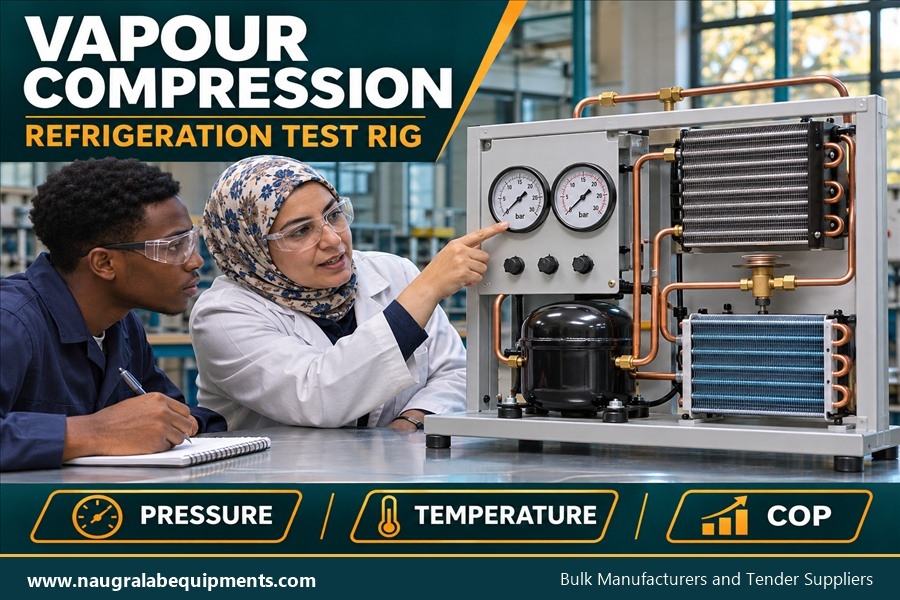
The rig lays these four parts out on a panel with gauges and sensors between them, so students can follow the refrigerant round the loop.
| Reading | Where it is taken | Used to find |
|---|---|---|
| Suction pressure | Before the compressor | Evaporating temperature; state of vapour entering the compressor |
| Discharge pressure | After the compressor | Condensing temperature; pressure ratio |
| Refrigerant temperatures | At four points round the loop | The corners of the cycle on a pressure-enthalpy chart |
| Refrigerant flow | In the liquid line | Mass flow, and from it the cooling capacity |
| Compressor power | Energy meter or wattmeter | Work input |
| Water or air temperatures and flow | At evaporator and condenser | Heat removed and heat rejected, as a cross-check |
The coefficient of performance (COP) is the cooling effect divided by the work put in. Students find it two ways and compare.
The theoretical COP comes from plotting the four measured states on a pressure-enthalpy chart for the refrigerant and reading off the enthalpy change in the evaporator and in the compressor.
The actual COP comes from the heat removed from the water or air at the evaporator, divided by the electrical energy the compressor used.
The actual figure is always lower. Explaining why, in terms of motor losses, pressure drops and heat leaks, is the real lesson of the practical. A rig without flow and power measurement cannot give an actual COP, so check for both.
One rig does not make a refrigeration lab. Depending on the course, add:
See refrigeration and air conditioning trainers, AC and refrigeration lab and refrigeration and air conditioning lab equipment.
Engineering degree students need measurement: sensors at every point and enough data for a full heat balance. TVET students need hands-on service skills: recovering and charging refrigerant, evacuating a system, brazing, finding leaks and tracing electrical faults. For them, trainers with fault switches and service valves matter more than a flow meter. Buy both kinds if the centre teaches both groups.
Allow ventilation, because condensers reject heat into the room. Water-cooled rigs need a supply and drain. Provide a stable power supply with correct earthing; compressors do not tolerate low voltage well, so add a stabilizer where supply dips. Keep a refrigerant leak detector and a fire extinguisher in the room.
In a tender, ask every bidder to list the experiments the rig supports and the instruments fitted. That list is the fairest basis for comparison, since rig names differ between makers.
Skills projects that equip several centres should specify one model for all, with a set of service tools and consumables per centre: gauges manifold, vacuum pump, charging hoses, brazing kit. These are often forgotten and the trainers then sit unused. Distributors can supply rigs under their own brand, with their nameplate and manual.
Related posts: heat transfer lab equipment, STEM lab equipment list for engineering colleges and TVET equipment for Kenya.
It shows the four stages of the refrigeration cycle, compression, condensation, expansion and evaporation, and lets students measure pressures, temperatures, flow and power to calculate the coefficient of performance.
Theoretical COP is read from a pressure-enthalpy chart using the measured states. Actual COP is the heat removed at the evaporator divided by the electrical energy used by the compressor.
Yes. Compressors are built for a set voltage and frequency. State whether your supply is 50 Hz or 60 Hz, and the voltage, on the order.
Ask for the refrigerant with the quotation and check that it is permitted and available in your country before ordering.
They can, but trade courses also need trainers with fault simulation and service valves for hands-on practice.
Send the course level, list of experiments and your mains supply details. Write to sales@naugralabequipments.com or send the details through our contact page.
Talk to our specialists about your laboratory setup or bulk-tender requirements.
