

 Quality Lab Equipment Manufacturer & Supplier
Bulk Tender
Tender Supply
Precision Instruments
Suppliers India
Microscopes are the most expensive line in most school science orders and the one most often bought badly. Two instruments that look the same in a photograph can differ in optics, light source and build quality by a wide margin. In a 500-unit tender, that difference is the whole value of the contract.
Naugra Lab Equipments manufactures and supplies microscopes and laboratory equipment from Ambala Cantt, Haryana, India, for tender, bulk and own-brand orders across Africa.
| Part | What it does | What to state in the order |
|---|---|---|
| Eyepiece | Magnifies the image formed by the objective | Magnification (usually 10x), wide field or standard, one or two eyepieces |
| Head | Holds the eyepiece and sets the viewing angle | Monocular, binocular or trinocular; inclined; rotating or fixed |
| Nosepiece | Carries the objectives and turns them into place | Number of positions (three or four) |
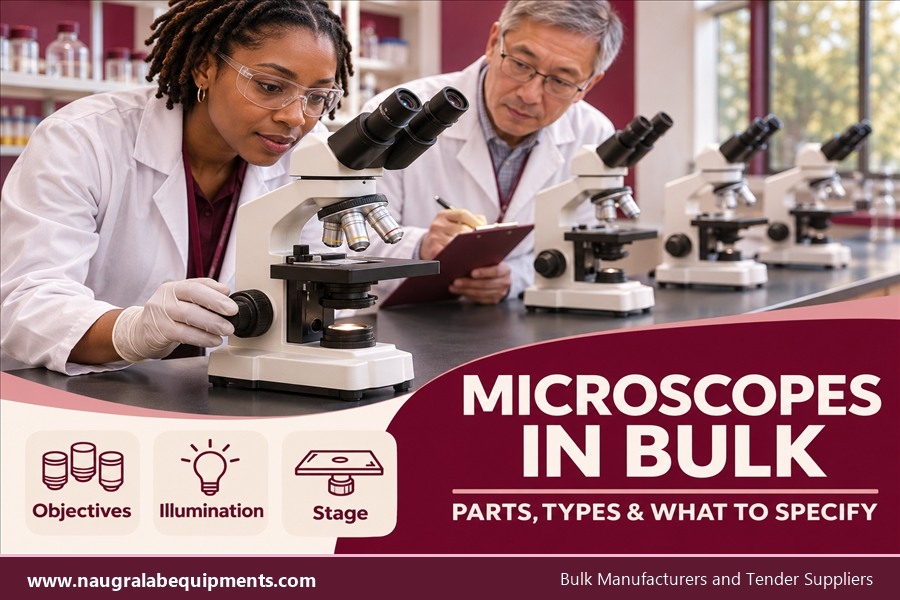
| Objectives | Form the first magnified image; the main factor in image quality | Magnifications, achromatic or better, spring-loaded high powers |
| Stage | Holds the slide | Plain with clips or mechanical with controls; size |
| Condenser and diaphragm | Gather and control light onto the specimen | Type, numerical aperture, iris or disc diaphragm |
| Light source | Illuminates the specimen | LED, halogen or mirror; mains, rechargeable or both |
| Focus controls | Move stage or tube to sharpen the image | Coarse and fine; separate or coaxial; focus stop |
| Stand and base | Carry everything and keep it steady | Metal construction, weight, carrying handle |
Total magnification is the eyepiece power multiplied by the objective power. A 10x eyepiece with a 40x objective gives 400x. Higher numbers do not mean better: a sharp 400x image teaches more than a dim, blurred 1000x one.
The Student Microscope and Monocular Microscope are the workhorses of secondary schools. One eyepiece, three objectives, simple stage. They are light, sturdy and easy to teach with.
A Binocular Microscope is more comfortable for long sessions and suits colleges, nursing schools and clinical labs. A Trinocular Microscope adds a port for a camera, which lets a teacher show the image on a screen.
A Stereoscopic Zoom Binocular Microscope gives a low-power, three-dimensional view of whole objects: insects, flowers, rocks, circuit boards. A Dissecting Microscope is the simpler school version. These are not substitutes for a compound microscope; a biology lab needs both kinds.
A Projection Microscope throws the image onto a screen for group teaching. Research microscopes have better optics and coaxial controls for university work. A Tissue Culture Microscope is inverted, so cells can be viewed through the base of a culture vessel.
All types are under microscopes and research microscopes.
For a national programme, order a mix. Send rechargeable or mirror units to schools without reliable supply, not the same mains-only model to every site. State the country's voltage, frequency and plug type for mains units.
A complete line for a school microscope reads like this: monocular head inclined and rotating; 10x wide field eyepiece; triple nosepiece; achromatic objectives 4x, 10x and 40x, the 40x spring-loaded; stage with clips; condenser with iris or disc diaphragm; LED light, rechargeable; coarse and fine focus with stop; metal body; dust cover; in a foam-packed carton. Each phrase closes a gap that a low bidder could otherwise use.
Ask for one sample before award. Check it with a prepared slide at every objective. The image should be sharp to the edge, the focus should hold without drifting, and the stage should not wobble.
Contractors should fix the model by sample and keep that sample sealed until delivery is accepted. It settles any later argument about what was ordered.
Distributors can order microscopes with their own brand on the body, carton and manual. Agree the artwork early, because nameplates are made before assembly. Keep spare objectives and LED modules in stock; schools will come back for them.
For multi-school deliveries, ask for cartons marked by school and a serial number list per site. It makes asset registers easy.
See also high school science laboratory equipment and research lab equipment.
Eyepiece, head, nosepiece, objectives, stage, condenser with diaphragm, light source, focus controls and the stand.
A monocular or student microscope with 4x, 10x and 40x objectives and LED lighting. Choose rechargeable or mirror lighting where power is unreliable.
A compound microscope views thin specimens on slides at high magnification. A stereo microscope views whole objects in three dimensions at low magnification.
Around five percent of the order quantity in bulbs or LED modules, fuses, and a few spare objectives and eyepieces is a reasonable guide.
Yes. For own-brand orders we mark the body, carton and manual with your name. Send artwork when you confirm the order.
Tell us the type, quantity, power option and delivery country. Write to sales@naugralabequipments.com or send the details through our contact page.
Talk to our specialists about your laboratory setup or bulk-tender requirements.
