

 Mechanical Lab Equipment Specialists
Bulk Tender
Tender Supply
Manufacturers
Worldwide Export
Training workshops are often equipped from the top down: the budget goes on a few large machines, and the trainees then queue for them with no files, no vices and no measuring tools of their own. A fitter is made at the bench first. The machines come second.
Naugra Lab Equipments manufactures and supplies workshop machines, tools and training equipment from Ambala Cantt, Haryana, India. We supply TVET institutions, skills projects, tender contractors and distributors across Africa.
Every trainee needs a place at a bench with a vice and a personal set of hand tools. For a class of 20, that is 20 vices and 20 tool sets, not five.
| Group | Tools | Basis |
|---|---|---|
| Holding | Bench vice, soft jaws | One per trainee |
| Cutting | Hacksaw frame and blades, files (flat, half-round, round, square, triangular), cold chisels | One set per trainee |
| Striking | Ball-pein hammers, soft mallet, punches | One set per trainee |
| Marking out | Steel rule, scriber, centre punch, try square, dividers, odd-leg calipers | One set per trainee |
| Measuring | Vernier caliper, micrometer, Feeler Gauge, Thread Gauge, combination set | One per two trainees |
| Fastening | Spanner and socket sets, screwdrivers, pliers, Allen keys, Strap Wrench | One set per four trainees |
| Threading | Taps and dies with wrenches and stocks | One set per four trainees |
| Shared at the bench | Surface plate, V-blocks, angle plate, height gauge, marking-out table | One or two per workshop |
Catalogue sections: workshop tools and workshop machines and workshop tools.
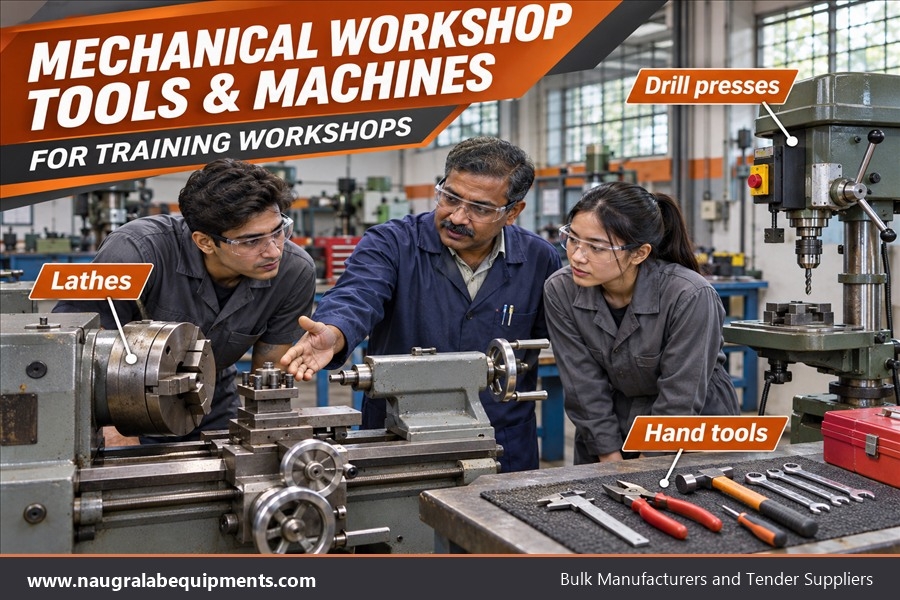
Turning, milling, drilling, shaping and grinding. Core machines are the centre lathe, Universal Milling Machine, Pillar Drill Machine, Radial Drilling Machine, Shaping Machine, pedestal grinder and power hacksaw. Machine vices such as the Drilling Machine Vice and Tilting and Swiveling Vice are small items that are often missing. See lathes, milling machines and drilling machines.
Arc, gas and resistance welding, with cutting and forming. A section needs a Manual Metal Arc Welding Machine per booth, one or two TIG sets, a Spot Welding Machine, gas welding and cutting sets, and welding tables. See welding equipment.
Shears, folders, rollers and hand tools for marking and forming thin sheet. See hand-operated sheet metal machines and the shearing machine.
Many institutions run these beside the metal trades. See carpentry workshop equipment and plumbing workshop equipment. A Carpenter Workbench per trainee and a Claw Hammer in every kit are the basics.
Work from trainee-hours. If the timetable gives each trainee six hours a week of turning and the class is 20, the lathes must provide 120 lathe-hours a week. With 30 workshop hours in the week, that means at least four lathes for one class, and more if several classes share the shop. Do the same sum for each machine type. It is a simple calculation, and it is the strongest argument a principal can put in a funding request.
Order personal protection with the tools: safety glasses, helmets, welding shields, gloves, aprons, ear protection and safety boots, plus machine guards, first aid kits and fire extinguishers. See safety and body protection equipment and our safety guide for TVET labs.
A workshop consumes material every day. Include hacksaw blades, files, drill bits, lathe tools and inserts, grinding wheels, welding electrodes, gas, cutting fluid and practice stock in bar, plate and sheet. A new workshop with no steel to cut cannot train anyone.
Skills projects usually equip several centres to one design. Three practices help.
Contractors should request packing by centre and by section, with tool sets boxed individually so they can be issued to trainees on day one. Distributors can supply tool kits under their own brand and hold blades, bits and electrodes as repeat lines.
Related posts: workshop machines for Kenya, TVET equipment for Kenya and STEM lab equipment list for engineering colleges.
A bench vice and hand tool set for each trainee, shared measuring and marking-out tools, and machines for turning, milling, drilling, grinding, welding and sheet metal work.
Work it out from the timetable. Multiply trainees by weekly lathe hours each and divide by the workshop hours in a week. A class of 20 with six hours each needs about four lathes.
Yes for basic bench tools. Shared kits lead to waiting and to missing tools. Measuring tools can be shared between two trainees.
Our catalogue includes workshop tools and machines. Send your complete list and we will mark anything we cannot supply.
Yes. Tool kits and cartons can carry a distributor's brand and item codes when artwork is sent with the order.
Send the trades taught, class sizes and timetable hours, or your tender schedule. Write to sales@naugralabequipments.com or send the details through our contact page.
Talk to our specialists about your laboratory setup or bulk-tender requirements.
