

 Quality Lab Equipment Manufacturer & Supplier
Material Testing
Manufacturers
Suppliers India
ISO Quality
An autoclave that is too small runs all day and still leaves media waiting. One that is too large wastes water and power on half loads. Most sizing mistakes happen because the buyer chose from a price list, not from the daily load. This guide starts from the load.
Naugra Lab Equipments manufactures and supplies laboratory equipment from Ambala Cantt, Haryana, India. We supply autoclaves to colleges, hospitals, research labs and tender contractors in Africa.
An autoclave is a pressure vessel. Water is boiled in a closed chamber, so the steam rises above 100 °C. Saturated steam at about 121 °C, held for 15 to 20 minutes, is the common cycle for culture media, glassware and instruments. Some loads use a hotter, shorter cycle near 134 °C.
Steam must reach every surface. Air trapped in the chamber or inside wrapped packs blocks the steam, so the load has to be packed loosely and the air has to be driven out first. Time is counted from the moment the whole load reaches temperature, not from switch-on.
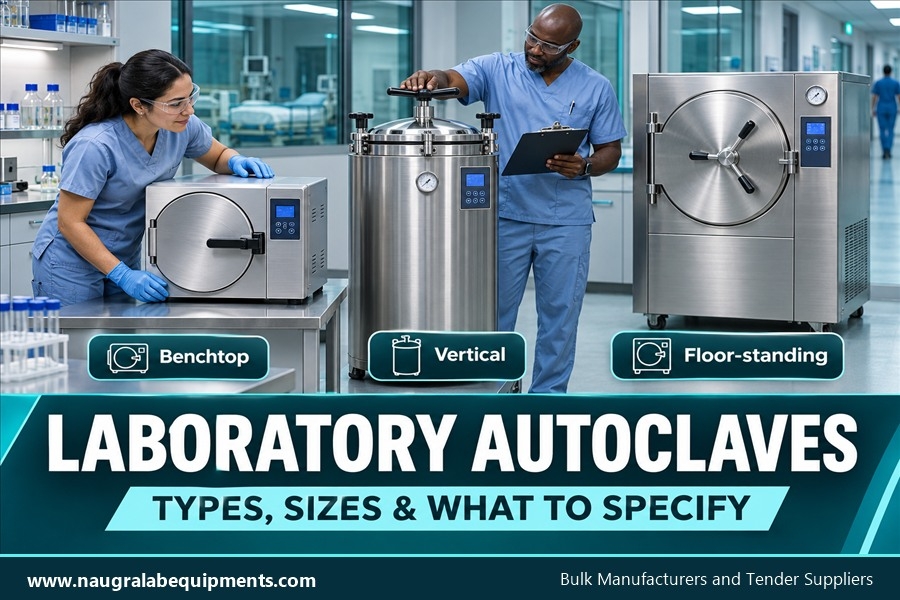
| Type | Loading | Suits | Model to see |
|---|---|---|---|
| Portable | Top, lifted lid | Field clinics, small school labs, a few flasks at a time | Naugra Lab Portable Autoclave |
| Table-top | Front door | Dental and clinic instruments, small microbiology rooms | Naugra Lab Table Top Autoclave |
| Vertical | Top | Teaching and research labs, media bottles and flasks in baskets | Naugra Lab Autoclave Vertical |
| Horizontal, cylindrical | Front door | Hospitals and central sterile rooms with drums and trays | Naugra Lab Autoclave Horizontal |
| Horizontal, rectangular | Front door | Larger hospitals and institutes where shelf space matters | Naugra Lab Rect. Horizontal Autoclave |
All models are listed under autoclaves.
A vertical autoclave takes little floor space and costs less for the same volume. Loads are lifted in and out from the top, which is fine for baskets of bottles. A horizontal autoclave is easier to load with trays and heavy drums, and it suits staff who sterilize all day. Laboratories usually choose vertical. Hospitals usually choose horizontal.
Ask the supplier for the inside chamber dimensions as well as the capacity in litres. Two chambers with the same volume can have very different shapes.
Hard water leaves scale on heaters and shortens their life. Use distilled or deionized water where the maker says so. Plan a drain for the discharge, enough clearance to open the lid or door, and ventilation, because the room gets hot and damp. Keep spare gaskets, heater elements and a safety valve in store. In remote sites these small parts decide whether the autoclave works next month.
Steam does not suit everything. Powders, oils and some glassware are sterilized by dry heat in a Hot Air Sterilizer. Sterile work after autoclaving needs a clean bench such as the Naugra Lab Vertical Laminar Air Flow Cabinet, and cultures then go to a bacteriological incubator. See clean air equipment and incubators. Hospital buyers can also see hospital and medical equipment.
Health and education projects often buy one autoclave model for dozens of sites. Three points reduce trouble later.
First, sort the sites by workload and fix one model for each group, such as portable for health posts and vertical for district labs. Second, add a spares kit per unit to the bill of quantities, priced as its own line. Third, ask for operator instructions in the working language of the staff, and for a wall chart that shows the cycle steps.
Distributors who sell under their own brand can have nameplates, manuals and cartons printed with their name. Agree this at order stage.
A common cycle is about 121 degrees C held for 15 to 20 minutes. Some loads use about 134 degrees C for a shorter time. Follow the method for your material.
Most college labs choose a vertical autoclave. It takes less floor space and suits baskets of bottles and flasks. Horizontal units suit hospitals with trays and drums.
Small portable, table-top and vertical units usually can. Larger units may need three-phase power. State your supply when you ask for a quote.
Yes. We recommend ordering a spares kit with each autoclave, especially for sites far from a service centre.
Send your daily load, site power details and the number of units. Email sales@naugralabequipments.com or use the contact page. You can also add items to an enquiry from the product catalogue.
Talk to our specialists about your laboratory setup or bulk-tender requirements.
