

 Mechanical Lab Equipment Specialists
Africa Exports
Suppliers India
Engineering Lab
Worldwide Export
Ask a first-year mechanical trainee what backlash, end float or belt creep is, and most will offer a textbook definition. Ask them to measure it and many cannot. Terms like these only make sense when a trainee has turned the gear, felt the slack and read the dial. Machine elements are learned with the hands.
Naugra Lab Equipments manufactures and supplies engineering teaching models and apparatus from Ambala Cantt, Haryana, India. We supply TVET colleges, polytechnics, skills projects and distributors across Africa.
| Component group | Basic terms trainees should be able to show | Teaching apparatus |
|---|---|---|
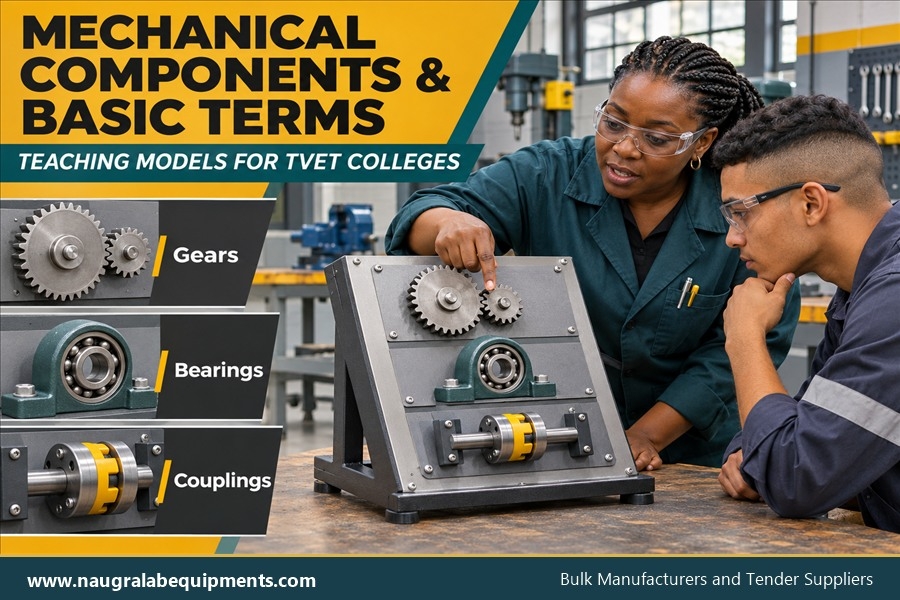
| Gears and gear trains | Gear ratio, module, backlash, idler, epicyclic train, torque | Epicyclic Gear Train and Holding Torque Apparatus, gear demonstration set, planetary gear model |
| Belts, chains and pulleys | Velocity ratio, slip, creep, tension, wrap angle | Belt slip and creep apparatus, Chain Pulley Block |
| Bearings and lubrication | Journal, bush, rolling element, oil film, friction coefficient | Journal Bearing Apparatus, Hydrodynamic Journal Bearing |
| Couplings and shafts | Misalignment, flexible and rigid couplings, universal joint | Universal Coupling, Flexible Coupling, Sellers Coupling |
| Cams and followers | Lift, dwell, follower jump, cam profile | Cam Analysis Apparatus, Cam Mechanism |
| Governors and flywheels | Speed regulation, sensitivity, stability | Universal Governor Apparatus |
| Balancing | Static and dynamic balance, vibration | Static and Dynamic Balancing Apparatus |
| Springs and friction | Stiffness, deflection, static and kinetic friction | Spring Testing Apparatus, dry friction apparatus |
| Gearboxes | Sliding mesh, constant mesh, gear selection | Sliding mesh gearbox cut section |
See theory of machines models, dynamics of machines and engineering mechanics and machine elements.
Before any apparatus, trainees should handle real parts. A component board or tray with sectioned bearings, gears of different types, keys and keyways, splines, circlips, seals, bolts, nuts, washers, rivets and pins, each labelled, takes a single lesson to make familiar what textbooks describe for a whole term. Colleges can build these from scrap with their workshop, or order sets with the apparatus.
A machine elements lab is worth its cost when each term is tied to a reading:
Each of these fits one practical session for a group of four or five trainees.
A machine elements lab for a class of 20 can run with six to eight apparatus, each used by a group, and groups rotating through the term. Benches should be heavy and level, with single-phase power for motorised apparatus and guards on all moving parts. Keep tools, spare belts and lubricants on a shadow board. A short laminated sheet beside each apparatus, with the steps and a results table, saves instructor time.
The same components appear in machines trainees use in the workshop and in vehicles. Point to the gearbox on the lathe, the belt on the drill and the bearings in the axle. Colleges running motor vehicle courses can share cutaway gearboxes and differentials with the machine elements lab. See mechanical workshop tools and machines, automotive workshop tools and trainers and Mechanical Engineering Lab Equipment.
TVET colleges: write the tender as a list of learning outcomes and the apparatus that shows each one. Ask for experiment manuals with sample readings, so new instructors can check the apparatus works.
Skills projects: equip several colleges to one standard list so instructor training and spares can be shared. Ask for a spares kit of belts, springs, bearings and fuses per college.
Distributors: component boards and simple models sell well to smaller colleges and private training centres. They can carry your brand; see OEM and contract manufacturing. Related: STEM lab equipment list for engineering colleges and TVET Equipment Supplier in Kenya.
Working apparatus for gear trains, belt drives, bearings, couplings, cams, governors, balancing, springs and friction, plus a board of real sectioned parts.
For a class of 20, six to eight apparatus used by rotating groups is usually enough to cover the syllabus over a term.
Gear ratio, efficiency, belt slip, coefficient of friction, spring stiffness, imbalance and cam follower behaviour, among others.
Ask for manuals with procedures and sample readings in the quotation, so instructors can check each apparatus works.
Yes. Cutaway gearboxes and differentials serve both, and the same components appear in vehicles and workshop machines.
Send the syllabus or learning outcomes, class size and power supply. Write to sales@naugralabequipments.com or send the details through our contact page.
Talk to our specialists about your laboratory setup or bulk-tender requirements.
