

 Quality Lab Equipment Manufacturer & Supplier
Precision Instruments
Suppliers India
Manufacturers
Tender Supply
A fume hood that is not ducted properly is a cupboard with a light in it. Across Africa, new laboratories are handed over with hoods that recirculate fumes into the room, or that were never connected because the duct route was not planned and the blower was not ordered. The hood itself was fine. The project around it was not.
Naugra Lab Equipments manufactures and supplies fume hoods and laboratory equipment from Ambala Cantt, Haryana, India. We supply lab builders, turnkey contractors, universities and distributors across Africa.
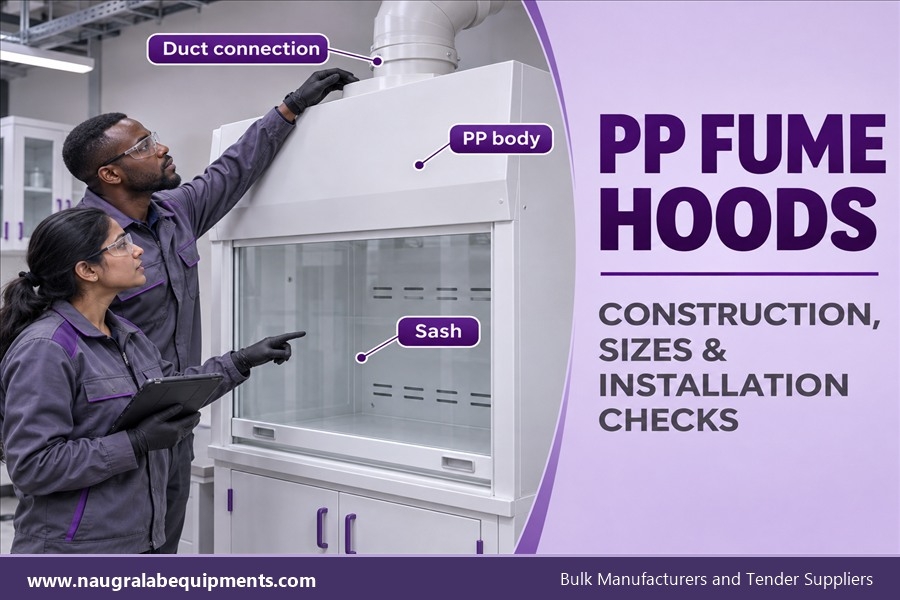
PP is polypropylene, a plastic that resists most acids, alkalis and salts. A PP fume hood is built from welded polypropylene sheet, so there is no metal inside the working chamber to corrode. That makes it the usual choice for acid digestion, metal analysis, etching and any work with hot mineral acids.
| Material | Strengths | Limits | Typical use |
|---|---|---|---|
| Polypropylene (PP) | No rust; resists most acids and alkalis; seamless welded liner | Softens with high heat; attacked by some solvents and strong oxidizers | Acid digestion, trace metals, water and soil labs |
| Epoxy-coated steel | Strong; economical; good general resistance | Coating can chip, then steel rusts under acid fumes | Teaching labs, general chemistry |
| Stainless steel | Heat resistant; easy to clean | Attacked by hydrochloric acid and chlorides | Solvents, radioisotope and clean work |
| Special construction | Wash-down system and compatible materials | Dedicated to one hazard | Perchloric acid work |
Perchloric acid needs its own dedicated hood with a water wash-down system; see the Naugra Lab Perchloric Fume Hoods. Do not specify a standard hood of any material for it. If your work mixes acids and solvents, tell the supplier the chemicals and temperatures involved.
Our range includes the Naugra Lab Fume Hood, Naugra Lab Junior Fume Hoods, Naugra Lab Mono Fume Hoods, Naugra Lab Duo Fume Hoods, Naugra Lab Acela Fume Hoods and Naugra Lab Fume Hood Deluxe Model. See laboratory fume hoods.
Hoods are ordered by external width. Widths around 900, 1200, 1500 and 1800 mm are common, with the usable chamber somewhat narrower. A 1200 mm hood suits one user; 1500 to 1800 mm suits two students side by side or larger apparatus. State:
A hood protects by drawing room air in through the sash opening fast enough to hold fumes inside. Many specifications ask for an average face velocity of roughly 0.4 to 0.6 metres per second at the working sash height, and quote EN 14175 or ASHRAE 110 for testing. Use the figure and standard your own safety rules require, and ask the supplier to state the design airflow and what the hood has been tested to. Faster is not safer: too much velocity causes turbulence that pulls fumes out.
Where acid fumes cannot be released untreated, a fume scrubber washes the exhaust before discharge. Check your environmental rules. Ductless, filtered hoods suit light duties only and are not a substitute for a ducted hood in a teaching or digestion lab.
At handover, ask for a smoke test at the sash and a face velocity reading across the opening, both recorded. Mark the working sash height on the frame. After that, check airflow at least yearly, keep the baffles clear, and do not store bottles in the chamber.
On building projects the fume hood sits between two contracts: the builder's and the equipment supplier's. Ducts, roof penetrations and blower power are often in neither. Decide in writing who supplies and fixes each part: hood, duct, blower, weather cowl, electrical connection and commissioning test.
Tender writers should attach a room drawing with the hood position and duct route. Bidders can then price real duct lengths. For microbiology, note that a fume hood protects the user from chemicals, not samples from contamination; that needs a biosafety cabinet.
Related posts: chemistry lab requirements for colleges, turnkey science laboratory setup and environmental lab instruments.
A fume hood built from polypropylene, a plastic that resists most acids and alkalis. It has no metal in the working chamber to corrode, so it suits acid digestion and similar work.
For high-temperature work, for some organic solvents and strong oxidizers, and for perchloric acid, which needs a dedicated wash-down hood. Tell the supplier your chemicals and temperatures.
A 1200 mm hood suits one user and 1500 to 1800 mm suits two students. The number of hoods depends on class size and the practicals taught.
A standard fume hood does. The duct and blower carry fumes out of the building and are as important as the hood.
Send your room drawing and duct route. We will state what we can supply with the hood and what should be done locally.
Send the chemicals used, hood sizes, and a sketch of the room with the duct route. Write to sales@naugralabequipments.com or send the details through our contact page.
Talk to our specialists about your laboratory setup or bulk-tender requirements.
