

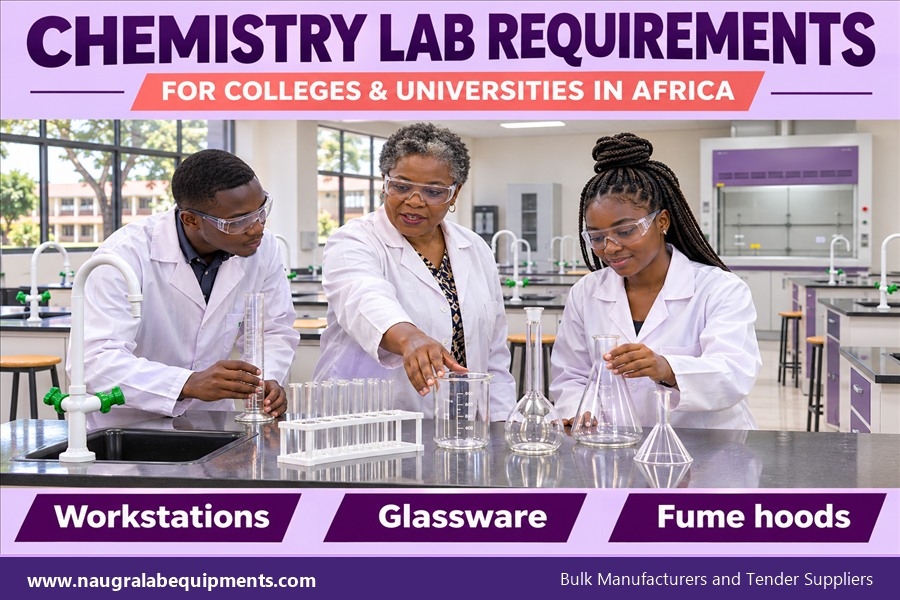
 Chemistry Lab Equipment & Glassware
Material Testing
ISO Quality
Engineering Lab
Bulk Tender
A college chemistry lab is not a bigger school lab. School chemistry can run on beakers, burners and a balance. Degree and diploma courses need controlled heating, vacuum, pure water, fume extraction and instruments that give a number students can defend. Departments that scale up a school list end up with cupboards of glassware and no way to run the second-year syllabus.
Naugra Lab Equipments manufactures and supplies laboratory equipment from Ambala Cantt, Haryana, India. We supply universities, colleges, tender contractors and distributors across Africa.
| Laboratory | What students do | Equipment beyond basic glassware |
|---|---|---|
| General and inorganic | Qualitative analysis, gravimetric work, preparations | Centrifuge, hot air oven, muffle furnace, desiccators |
| Analytical (volumetric) | Titrations, standard solutions | Analytical Balance, class A burettes and pipettes, magnetic stirrers, Digital PH Meter |
| Organic | Synthesis, distillation, recrystallisation, melting points | all-glass distillation apparatus, rotary vacuum evaporator, vacuum pump, melting point apparatus |
| Physical | Kinetics, conductance, optical rotation, viscosity | Digital Conductivity Meter, polarimeter, thermostatic water bath, viscometer |
| Instrumental | Spectroscopy, flame emission, chromatography | Microprocessor Spectrophotometer, Flame Photometer, chromatography columns |
| Preparation room | Reagents, pure water, cleaning | water still, ultrasonic bath, top-pan balance, reagent storage |
Catalogue sections: chemistry equipment, laboratory glassware, spectrophotometers and scientific lab instruments.
Three things change from school lists. Volumetric ware should be class A. Organic work needs jointed glassware, with flasks, condensers, adapters and columns such as Vigreux columns that fit together by ground-glass joints of one standard size. And filtration under vacuum needs Buchner flasks and sintered ware. State the joint size once for the whole lab. Mixed sizes are the usual reason a new organic lab cannot assemble its first distillation. See distillation glassware and sintered glassware.
Every lab needs an emergency shower and eyewash, fire extinguishers and a fire blanket, a first aid kit, spill kits, and goggles, gloves and coats for every student. Put these in their own lot with a protected budget. See safety and body protection equipment.
Chemicals are a separate purchase with their own rules. Many reagents are regulated for transport, and some need permits to import. Plan storage before ordering: ventilated cabinets, acids apart from bases, oxidizers apart from flammables, and a locked store for controlled substances. Order quantities for one year, not five, because many reagents degrade. See laboratory chemicals. Ask your clearing agent which reagents on your list are restricted in your country before you tender.
Work from the largest practical group and the number of students per station. For glassware and small apparatus, one set per student or pair. For bench instruments such as pH meters and stirrers, one per four students. For major instruments, one per lab with a timetable. Add ten percent spare glassware for breakage in the first year.
University tenders are often written by department, with lots for glassware, equipment, instruments, furniture and chemicals. Three points help bidders give useful offers.
First, state accuracy and range for every instrument, as in our analytical and measuring instruments list. Second, state joint sizes and glass type for glassware, as in the science laboratory apparatus reference table. Third, ask bidders to include installation, user training and a first set of consumables for each instrument: cuvettes, electrodes, lamps and standards.
Contractors should check that fume hoods are included in the building works or the equipment contract, not left between the two. Distributors supplying several colleges can hold glassware, electrodes and common spares in local stock under their own brand.
Beyond glassware it needs balances, ovens, a furnace, stirrers and hot plates, pH and conductivity meters, distillation and vacuum equipment, a water still, fume hoods and at least a spectrophotometer for instrumental work.
As a planning guide, one fume hood working place for every four to six students in organic and inorganic sessions. Check your national laboratory safety rules.
Yes for volumetric ware used in analytical chemistry. Class B is acceptable for rough measuring.
Send your reagent list. We will mark what we can supply and what is restricted for shipping, so you can plan local purchase where needed.
Fume hoods are in our catalogue. Send your room layout and we will advise what we can supply with the equipment.
Send the practical list by year, student numbers and room details. Write to sales@naugralabequipments.com or send the details through our contact page.
Talk to our specialists about your laboratory setup or bulk-tender requirements.
