

 Laboratory Glassware Manufacturer
Tender Supply
Manufacturers
Africa Exports
Precision Instruments
A biology lab is often the last of the three science rooms to be equipped properly. Physics gets meters, chemistry gets glassware, and biology gets one microscope and a skeleton in the corner. Yet biology practicals carry marks in every senior exam, and most of the equipment is cheap compared with the other two labs.
Naugra Lab Equipments manufactures and supplies school biology equipment from Ambala Cantt, Haryana, India. We work with ministries, tender contractors, school groups and distributors across Africa.
| Activity | Equipment | Quantity for a class of 40 |
|---|---|---|
| Look: microscopy | Student microscopes, blank slides, cover slips, stains, hand lenses | 10 microscopes, plus 1 for the teacher; 20 hand lenses |
| Look: prepared material | Prepared slides, botany slide set, bacteria slide set | One set per two microscopes |
| Test: physiology and food | Test tubes, racks, water bath, thermometers, dropper bottles, reagents | One set per group of four |
| Dissect | Dissection kits, dissecting trays or boards, pins | One per pair |
| Model | Skeleton, Heart Model, lungs and heart model, eye, ear, flower, cell and DNA models | One of each per room |
| Go outside: ecology | Quadrats, measuring tapes, trundle wheel, identification keys such as the Key to Identifying Common Grasses | 5 to 10 quadrats; keys per group |
| Store and preserve | Specimen jars, labels, a lockable cupboard | As needed |
See biology lab equipment, dissection equipment, prepared slides, human biology and genetics and inheritance.
Biology needs less glassware than chemistry but uses some items heavily:
Plastic petri dishes and beakers are cheaper and safer where glassware breaks often; use glass where heating is needed. For glass types and classes see borosilicate glassware specification.
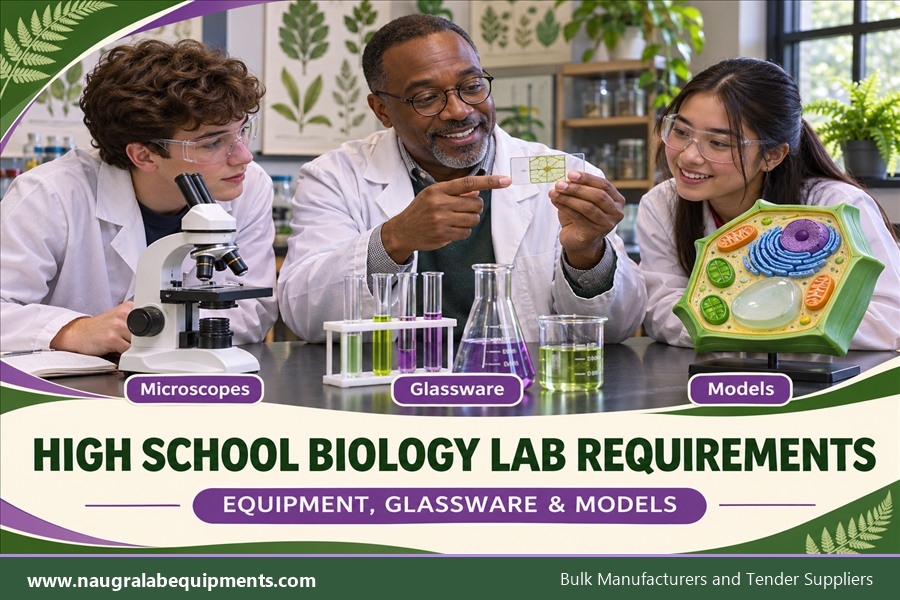
A microscope that cannot focus at high power puts learners off biology for good. For high schools, a monocular student microscope with 4x, 10x and 40x objectives, coarse and fine focus and an LED light that runs on batteries or mains is the usual choice. One microscope for every four learners is the minimum for a practical class. Our microscopes in bulk explains how to specify them.
Models replace specimens that are hard to obtain or keep: a human torso, heart, eye, ear, kidney and brain, a flower section, plant and animal cell models and a DNA model. Buy durable models that come apart and go back together, and a set of charts for the wall. See biological models.
Ecology is often taught only from the textbook, though the school grounds are a ready field site. A box of quadrats, tapes, keys, collecting jars and a trundle wheel lets learners measure plant cover and compare two areas in one lesson. It is one of the cheapest practicals to equip.
A biology lab needs good light for microscopy, sinks with running water, benches that can be disinfected, a lockable store for preserved specimens and stains, and a sharps container for blades. Wash hands after every practical. For general lab safety see school lab accidents and first aid.
Ministries and tender writers: write the biology lot by activity, as in the table, with the microscope specification spelled out. Separate models and charts into their own lot, since they are often supplied by different makers.
Contractors: pack slides and cover slips in sealed boxes inside the microscope cartons, so each school's microscopes arrive ready to use.
Distributors: sell a standard biology room pack and a yearly refill of slides, stains and dissection blades. See biology lab equipment for Botswana and OEM and contract manufacturing.
Student microscopes and slides, hand lenses, test tubes and a water bath for food and enzyme tests, dissection kits, models and charts, and simple fieldwork equipment such as quadrats and keys.
At least one for every four learners, so ten for a class of 40, plus one for the teacher.
Test tubes and boiling tubes, beakers, petri dishes, watch glasses, measuring cylinders and droppers. Plastic versions suit items that are not heated.
Yes, for structures that are hard to see in real specimens, such as the heart, eye, ear and brain. Choose durable models that come apart.
Yes. Send the class size and syllabus, and we will propose a pack with a yearly refill.
Send your syllabus topics, class size and number of schools. Write to sales@naugralabequipments.com or send the details through our contact page.
Talk to our specialists about your laboratory setup or bulk-tender requirements.
