

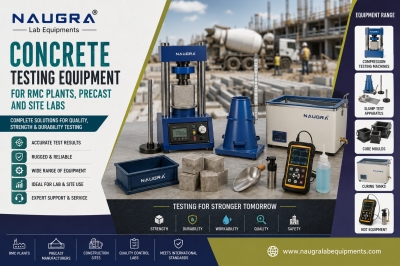
 Concrete & Material Testing Equipment
Manufacturers
Lab Equipment
Worldwide Export
Civil Testing
Concrete & Material Testing Equipment
Manufacturers
Lab Equipment
Worldwide Export
Civil Testing
Concrete gets tested twice — once while it is still workable and once after it has hardened. Commercial operations that test only the second half are running blind for 28 days. By the time a cube fails, the pour is in place, the pump has left and the argument is about remediation cost.
Naugra Lab Equipments manufactures concrete testing apparatus covering both stages, built to IS 516, IS 1199 and the equivalent ASTM and BS methods. For over 20 years we have supplied ready-mix operations, precast and prestressed plants, site and project laboratories, structural investigation firms and commercial testing laboratories across 90-plus countries.
The slump test is the most performed concrete test anywhere, and at a ready-mix plant it is the last practical check before dispatch. The apparatus is simple — truncated cone, tamping rod, base plate, scale — but the geometry is what the test compares against, so dimensional accuracy is the whole point.
For stiffer mixes where slump loses sensitivity, we supply compaction factor apparatus and the Vee-Bee consistometer. Flow table apparatus covers high-workability and self-compacting mixes, now standard in precast production.
Entrained air buys freeze-thaw durability at the cost of strength, so it is measured, not assumed. Our air entrainment meters use the pressure method with a calibrated gauge. Unit weight measures in standard capacities cover fresh density, which doubles as a yield check — a direct commercial control at any batching plant.
Specimen preparation is where laboratory error most often enters, and where a disputed result is most often defensible or not.
We manufacture cube moulds in 150 mm and 100 mm, cylinder moulds at 150 × 300 mm, and beam moulds for flexural work — cast iron or steel with machined faces that assemble square and strip cleanly. Moulds that go out of square produce low results, and low results at a ready-mix plant cost money that was never actually lost.
Compaction uses tamping rods or vibrating tables. Laboratory pan and drum mixers prepare trial batches for mix design.
Curing tanks with thermostatic control at 27 ± 2 °C are non-negotiable: strength development is temperature-sensitive, and uncontrolled curing destroys the comparison the test exists to make. We supply tanks across a range of capacities, with and without circulation, sized to specimen throughput.
The compression testing machine is the anchor of the laboratory. We manufacture motorised and fully digital machines from 1000 kN upward, with controlled load pacing, digital load indication, peak hold and printer or PC output. For a lab issuing certificates, the data output is not a luxury — it is the audit trail.
Flexural testing machines with two-point loading handle beam specimens for modulus of rupture, important in pavement quality concrete. Split tensile testing runs in the compression machine using jigs and packing strips we supply.
Where the structure is built and specimens cannot be cast, NDT takes over. We supply rebound hammers for surface hardness correlation, ultrasonic pulse velocity testers for homogeneity and void detection, rebar locators for cover and bar position, and core drilling machines with diamond bits where an actual specimen must be extracted for testing.
This is the equipment set for structural investigation, condition assessment and dispute resolution work.
Permeability apparatus, rapid chloride penetration sets, carbonation depth kits and accelerated curing tanks serve laboratories working to service-life specifications rather than 28-day acceptance alone. Accelerated curing in particular has direct commercial value — it gives a strength indication in hours rather than weeks.
Everything above is made at our own works, by our own engineering and quality-control staff. Mould faces are machined, not approximated. Load frames are designed for the loads they will actually carry, every day, for years.
Twenty-plus years of manufacturing is embedded in the specifications. Competitive Indian production keeps costs sensible without touching standards compliance. We export to over 90 countries with full documentation and dependable logistics.
Because our range covers civil, mechanical, electrical, electronics, educational, vocational and testing laboratories, a group with several facilities can work through one manufacturer. And we deliver turnkey — supply, installation, commissioning, operator training and continuing after-sales support.
What compression machine capacity suits a ready-mix laboratory? 2000 kN is standard for 150 mm cubes with margin for high-grade mixes. Tell us your grades and specimen types.
Do you supply machines with data logging for certificate issue? Yes — digital machines with peak hold, load pacing and printer or PC output.
Can you equip a project site laboratory? Yes, including transportable configurations for project-duration site labs.
Tell us what your concrete laboratory has to certify and we will build a quotation around it.
Naugra Lab Equipments | naugralabequipments.com
Talk to our specialists about your laboratory setup or bulk-tender requirements.
