

 Engineering Lab Equipment Manufacturer
Bulk Tender
Civil Testing
Africa Exports
Precision Instruments
A chemical engineering graduate is hired to run plants: columns, reactors, dryers and the control loops that hold them steady. Many African faculties teach these from textbooks because the pilot-scale rigs are expensive and the lab building was never designed for them. Students who have never started up a column or tuned a loop learn it on the job, at the employer's cost.
Naugra Lab Equipments manufactures and supplies engineering teaching equipment from Ambala Cantt, Haryana, India. We supply universities, polytechnics, project contractors and distributors across Africa.
| Lab area | Learning outcomes | Typical rigs |
|---|---|---|
| Mechanical operations | Size reduction, screening, filtration, mixing, settling | Ball mill, sieve shaker, filter press, agitator, settling column |
| Heat transfer | Exchanger performance, conduction, convection | Parallel and counter-flow heat exchanger, shell-and-tube exchanger, evaporator |
| Mass transfer | Distillation, absorption, extraction, drying | Manual Batch Distillation Pilot Plant, Continuous Distillation Pilot Plant, tray dryer, packed absorption column |
| Reaction engineering | Rate laws, reactor design, residence time | Batch Enzyme Reactor, Anaerobic Reactor, pressure reactor system |
| Process control | Sensors, loops, tuning, plant operation | Flow, level, pressure and temperature control trainers, Industrial Process Plant Trainer |
See chemical engineering trainers, process control trainers and pressure reactors.
Distillation is usually the largest rig in the lab. A manual column teaches the basics: reflux ratio, column profile, reading thermometers and taking samples. An automated column, such as the Automated Batch Distillation Pilot Plant or Automated Continuous Distillation Pilot Plant, logs temperatures and flows to a computer and lets students run longer experiments and compare models with data. Many departments buy one manual batch column for undergraduates and one automated continuous column for final-year projects and research.
Before ordering, decide the binary mixture students will separate. Ethanol and water are common because they are cheap and safe compared with organic solvents. The mixture sets the column material, heater rating, condenser duty and safety measures.
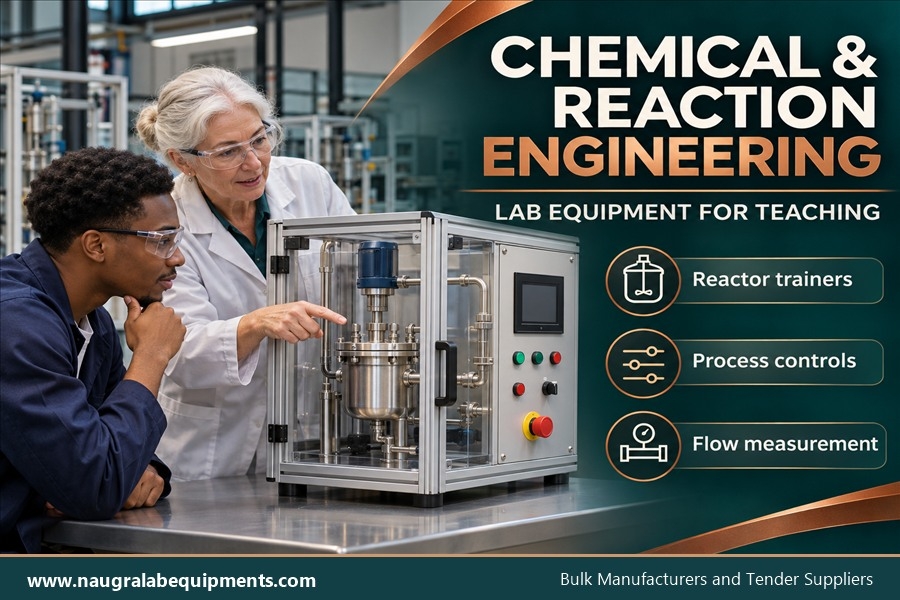
Teaching reactor labs normally run three types: a stirred batch reactor, a continuous stirred tank reactor (CSTR) and a tubular or plug-flow reactor, often with residence time distribution studies using a tracer. Saponification of ethyl acetate with sodium hydroxide is the classic reaction because conductivity follows its progress. Our catalogue lists batch, enzyme, anaerobic and pressure reactor systems. For CSTR, plug-flow or residence time rigs, send your list and we will mark which we can supply.
Control trainers let students see how a sensor, controller and valve behave together. Four single-loop trainers for flow, level, pressure and temperature cover the core syllabus. An Industrial Process Plant Trainer or Process Control Simulator Unit then joins them into a small plant with cascade and ratio control. Ask for trainers that use industrial transmitters and controllers, so graduates meet the same hardware at work, and for PLC or SCADA connection if your course covers it. See process control engineering.
Write the tender by lab area and list the experiments each rig must support. Ask each bidder for the experiment manual, sample results, utility needs and floor plan of every rig. This lets the estates department prepare the room before the crates arrive.
Include installation, commissioning with the department's own mixture, and training for technicians and lecturers. Ask for a spares kit: gaskets, heater elements, sensors, sight glasses and pump seals. Contractors should check that the building contract covers utilities to each rig position; see our post on turnkey science laboratory setup.
Distributors can support departments between projects with spares, calibration of sensors and consumables. Related posts: STEM lab equipment list for engineering colleges, fluid mechanics lab equipment, Heat Transfer Lab Equipment and tray dryers and pharmacy lab machines.
Rigs for mechanical operations, heat transfer, mass transfer, reaction engineering and process control, such as a ball mill, heat exchangers, distillation columns, reactors and control loop trainers.
Many departments buy a manual batch column for undergraduate basics and an automated continuous column for data logging, final-year projects and research.
Saponification of ethyl acetate with sodium hydroxide is common because its progress can be followed by conductivity. Choose what your syllabus and safety rules allow.
Our catalogue lists batch, enzyme, anaerobic and pressure reactor systems. Send your list and we will mark which reactor rigs we can supply.
Clear height, cooling water, compressed air, three-phase power, drains and, where solvents are heated, extraction and flameproof fittings.
Send the syllabus or experiment list, the room plan and the utilities available. Write to sales@naugralabequipments.com or send the details through our contact page.
Talk to our specialists about your laboratory setup or bulk-tender requirements.
