

 Soil & Geotechnical Testing Equipment
Tender Supply
Bulk Tender
Civil Testing
Precision Instruments
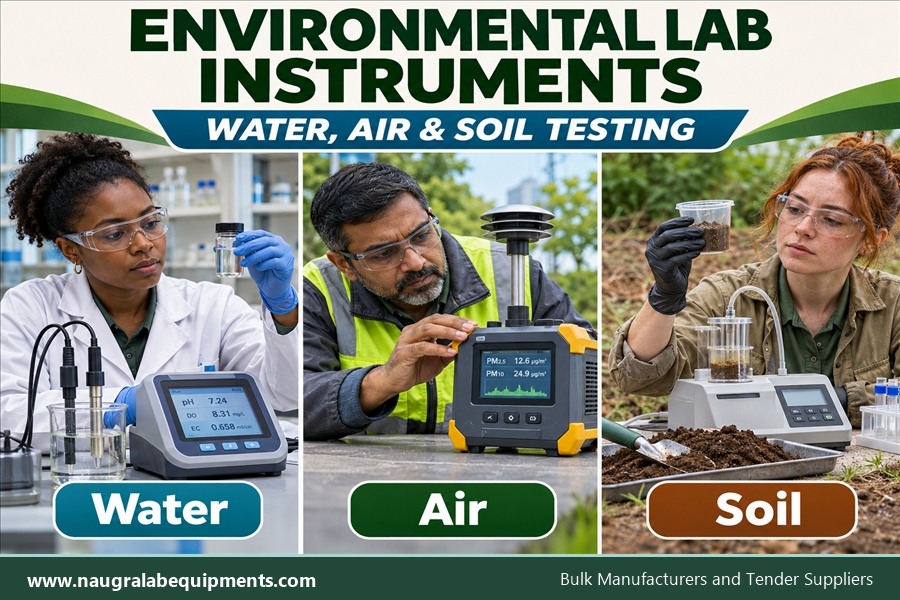
Water utilities, mining regulators, city councils and university departments across Africa all face the same demand: prove with numbers that water is safe, that effluent is within limits, that air and soil are not being damaged. Laboratories set up to answer that demand often buy a list of instrument names and then discover they cannot run a complete test, because the incubator has no bottles or the digester has no way to read the result.
Naugra Lab Equipments manufactures and supplies laboratory instruments from Ambala Cantt, Haryana, India. We supply universities, utilities, environmental agencies, tender contractors and distributors across Africa.
List what you must report. Each parameter needs an instrument, its accessories and its reagents. The table gives the common ones.
| Parameter | What it shows | Instrument | Also needed |
|---|---|---|---|
| pH | Acidity or alkalinity | Digital PH Meter | Buffers, spare electrode |
| Conductivity and TDS | Dissolved salts | Digital Conductivity Meter, Digital TDS Meter | Standard solution |
| Turbidity | Cloudiness of water | Digital Turbidity Meter | Calibration standards, sample cells |
| Biochemical oxygen demand (BOD) | Biodegradable organic load | BOD incubator | BOD bottles, dissolved oxygen measurement |
| Chemical oxygen demand (COD) | Total oxidisable load | COD digester | Digestion tubes, reagents, titration set or photometer |
| Coagulant dose | How much chemical clears raw water | Jar test apparatus | Beakers, coagulant stock solutions |
| Colour, nitrate, phosphate, iron, fluoride | Chemical quality | Microprocessor Spectrophotometer | Cuvettes, reagent kits |
| Sodium and potassium | Salinity, irrigation suitability | Flame Photometer | Standards, compressor, gas |
| Bacteria counts | Faecal contamination | Incubator, autoclave, colony counter | Media, filtration set, Petri dishes |
| Suspended and dissolved solids | Solids load | Drying oven, Analytical Balance, desiccator | Filter papers, dishes |
| Soil moisture and pH | Soil condition | Soil moisture meter, pH meter | Sieves, sample tins |
| Wind, pressure, rainfall | Local weather | Anemometer, Aneroid Barometer, rain gauge | Mast or enclosure |
Catalogue sections: environmental lab equipment, water testing equipment, meteorological instruments, hydrological instruments and environmental and bio engineering lab.
A treatment works needs daily checks on raw and treated water: pH, turbidity, residual chlorine, conductivity and bacteria, with jar tests whenever raw water changes. Bench instruments in the plant lab and a portable water testing kit for sampling points in the network cover most of it. Small rural schemes can start with the portable kit alone.
Discharge permits are usually written around BOD, COD, suspended solids, pH and sometimes metals and nutrients. BOD takes five days in an incubator held at 20 °C, so the incubator must hold a week of bottles. COD takes about two hours of digestion at high temperature with strong acid and needs a fume hood and careful waste handling. Plan both, because regulators often ask for both. See BOD incubators and COD digesters.
Ambient air work needs samplers for dust and gases, a sound level meter and a small weather station to interpret the readings. These are specialised lines. Send us your list and we will mark what we manufacture, what we can source and what we cannot offer. For teaching, weather instruments are the simplest start; see weather equipment.
Environmental soil work overlaps with agriculture and civil engineering: moisture, pH, conductivity, texture by sieving and nutrients by extraction. Extraction and digestion use the same spectrophotometer and flame photometer as the water lab, which is a good reason to plan the two together. For engineering soil tests see soil testing lab equipment.
Use field kits where samples change quickly or sites are far apart: pH, temperature, conductivity, turbidity and chlorine are best measured on the spot. Use bench instruments for anything that needs incubation, digestion or precise weighing. A regional lab normally has both, with the field results used to decide which samples go to the bench.
Write the tender by parameter and method. For each line, state the parameter, the range, the method your regulator accepts, and "complete with accessories and reagents for a stated number of tests". Bidders then price a working test, not a bare instrument.
Contractors equipping several district water labs should standardise on one model per instrument and include training for analysts and a first-year consumables kit per site. Distributors can stock electrodes, buffers, standards and BOD bottles as repeat items under their own brand.
Accredited laboratories need calibration certificates and traceable standards. Tell the supplier which instruments need them and which standard your accreditation body follows. Related posts: analytical and measuring instruments list, laboratory autoclaves and food technology lab equipment.
A pH meter, conductivity or TDS meter, turbidity meter, spectrophotometer, incubator and autoclave for bacteria, a balance and oven for solids, and jar test apparatus at treatment works.
BOD measures oxygen used by microbes to break down organic matter over five days. COD measures oxygen needed to oxidise almost all organic matter chemically in about two hours. COD is normally the higher figure.
For pH, conductivity, turbidity and chlorine, field kits are suitable. Tests that need incubation, digestion or precise weighing still need a bench laboratory.
Send your full list. We will mark the items we manufacture, those we can source and those we cannot offer.
Ask for each instrument complete with accessories and reagents for a stated number of tests, and we will quote it that way.
Send the parameters you must report, samples per day and site details. Write to sales@naugralabequipments.com or send the details through our contact page.
Talk to our specialists about your laboratory setup or bulk-tender requirements.
