

 Quality Lab Equipment Manufacturer & Supplier
Tender Supply
Worldwide Export
Lab Equipment
Precision Instruments
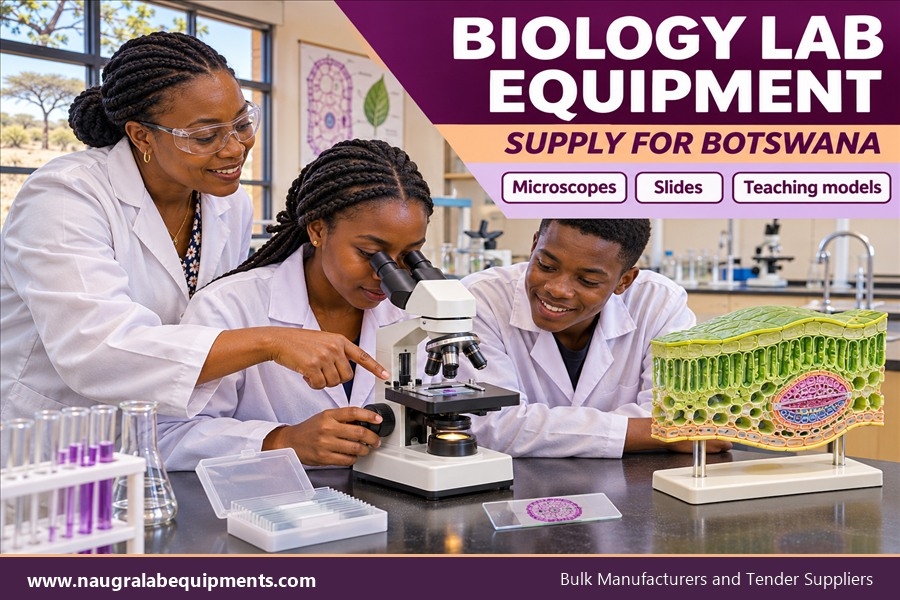
Biology is the science subject that most depends on each student seeing for themselves. A teacher can demonstrate a titration to forty students. Nobody can demonstrate a view down a microscope. Schools that are short of microscopes and slides end up teaching biology from diagrams, and results in practical papers show it.
Naugra Lab Equipments manufactures and supplies educational laboratory equipment from Ambala Cantt, Haryana, India. We supply school suppliers, tender contractors and institutions in Botswana and across southern Africa.
| Practical area | Core equipment | Suggested quantity for a class of 36 |
|---|---|---|
| Cells and tissues | Student Microscope or Monocular Microscope, prepared slides, blank slides and cover slips | 12 to 18 microscopes; one slide set per two microscopes |
| Micro-organisms | Bacteria Slide Set, Petri dishes, inoculating loops | 2 slide sets; 40 dishes |
| Plant and animal structure | Dissecting Microscope, hand lenses, dissection kits, dissecting boards | 6 dissecting microscopes; 18 kits and boards |
| Human body | Human skeleton, torso and organ models such as a brain model | 1 of each per lab |
| Section cutting (senior classes) | Hand and Table Microtome | 2 to 4 |
| Ecology and field work | Quadrats, nets, specimen jars, thermometers | 6 sets |
Quantities are a starting point for planning, not a rule. Adjust them to your class size and timetable. The catalogue sections are biology lab equipment, microscopes, prepared slides, dissection equipment and anatomical models.
For junior and senior secondary work, a monocular microscope with 4x, 10x and 40x objectives is enough. A 100x oil objective adds cost and is rarely used well at school level. Choose LED lighting: it runs cool and the lamp lasts. For schools in areas with unreliable power, ask for rechargeable units or a mirror option.
Buy one Binocular Microscope for the teacher, ideally with a camera port, so the class can see what to look for before they try themselves.
Many schools now limit animal dissection. Models, charts and prepared slides fill the gap and last for years. A sensible set for one lab covers the skeleton, torso, heart, eye, ear, kidney, skin and a flower and leaf section. See biological models.
This is a summary to help planning. Confirm the current rules, fees and route with a licensed clearing agent before shipment.
Dust is the main enemy of optics in much of Botswana. Three low-cost items protect the investment: a dust cover for every microscope, a lockable cupboard, and lens tissue with cleaning fluid. Add spare bulbs or LED modules and a few spare objectives to the order. Glass slides break; order prepared slides in plastic where the choice exists, and spare blank slides and cover slips by the box.
Government school supply in Botswana is often handled by local companies that source abroad. Three practices make those contracts easier to deliver.
Suppliers who sell under their own brand can have their name and item codes on each carton and manual. Tell us at order stage.
See also our guide to high school science laboratory equipment and the school science tender list.
One microscope for every two or three students is a workable target. For a class of 36, that is 12 to 18 microscopes.
A monocular or student microscope with 4x, 10x and 40x objectives and LED lighting suits most secondary school work.
Only products listed under Botswana's compulsory standards regulations. Ask your clearing agent to check your electrical items against the BOBS list.
Yes. We supply anatomical models, charts and prepared slide sets. Send the syllabus topics and we will suggest a set.
Yes. Send the complete science list and it can ship as one consignment.
Send your syllabus or kit list, the number of schools and class sizes. Write to sales@naugralabequipments.com or send the details through our contact page.
Talk to our specialists about your laboratory setup or bulk-tender requirements.
