

 Quality Lab Equipment Manufacturer & Supplier
Africa Exports
Precision Instruments
Tender Supply
ISO Quality
Quality Lab Equipment Manufacturer & Supplier
Africa Exports
Precision Instruments
Tender Supply
ISO Quality
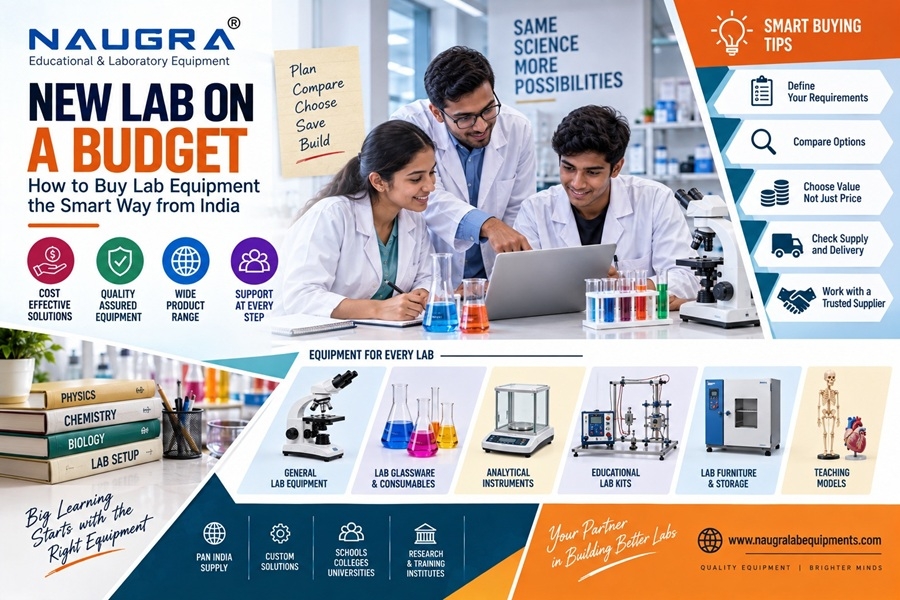
Setting up a new laboratory is an important investment for any school, college, university, technical institute, research centre or training organization. However, a good laboratory does not necessarily need the most expensive instruments available. The real objective is to purchase the right laboratory equipment in the right quantities while ensuring that the equipment supports the experiments, curriculum and practical training for which the laboratory is being established.
For institutions working with a limited budget, careful planning can make a substantial difference. Instead of simply reducing the number of instruments, buyers should prioritize essential equipment, compare specifications carefully and work with experienced laboratory equipment manufacturers in India that can supply multiple laboratory categories from one source.
Before preparing a laboratory equipment list, define exactly how the laboratory will be used.
A secondary school science laboratory has very different requirements from an engineering college, vocational training institute or research laboratory. Even within a school, Physics, Chemistry and Biology laboratories require different instruments.
The first questions should therefore be:
What subjects will be taught?
Which experiments are included in the curriculum?
How many students will use the laboratory at one time?
Will students work individually or in groups?
What equipment is essential for examinations and practical classes?
Which instruments can be shared?
What safety equipment is required?
Once these questions have been answered, it becomes much easier to prepare a realistic laboratory equipment budget.
One of the most effective ways of controlling laboratory costs is to divide the requirement into three groups: essential, useful and advanced.
Essential equipment consists of instruments required for regular practical work. These items should receive the highest priority.
For a Physics laboratory, this might include measuring instruments, spring balances, vernier calipers, micrometers, electrical meters, resistance apparatus, magnets, lenses, mirrors, prisms, calorimeters and mechanics apparatus.
A Chemistry laboratory may require beakers, burettes, pipettes, measuring cylinders, flasks, test tubes, stands, clamps, balances, heating equipment and basic measuring instruments.
A Biology laboratory may need microscopes, microscope slides, dissection instruments, anatomical models, biological specimens and teaching aids.
Advanced instruments can then be purchased according to the available budget and curriculum requirements.
This approach prevents a common mistake: spending too much money on a few sophisticated instruments while leaving insufficient funds for the equipment students use every day.
The lowest-priced laboratory is not always the most economical laboratory.
Imagine a class of 30 students with only one apparatus for an important experiment. Students may spend most of the practical period waiting instead of conducting the experiment.
For frequently performed experiments, institutions should calculate quantities according to practical group size.
If students work in groups of three and there are 30 students in a class, approximately ten experimental sets may be more appropriate than purchasing one or two expensive sets.
For less frequently used equipment, sharing between groups may be practical.
Good laboratory planning therefore considers both the unit price and the number of students who must use the equipment.
Two laboratory instruments that look similar in a quotation may differ considerably in construction, measuring range, materials, accuracy, accessories and intended application.
When comparing quotations from laboratory equipment suppliers in India, buyers should examine:
Technical specifications
Measurement range
Accuracy or resolution where applicable
Construction material
Included accessories
Power requirements
Dimensions where relevant
Safety features
Intended educational level
Spare parts or consumables
Packing requirements
A cheaper instrument that does not meet the required specification can ultimately become more expensive because it may need to be replaced.
For tender purchases, technical compliance becomes particularly important. Every quoted product should be checked against the BOQ or tender specification rather than selected only according to price.
Buying Physics equipment from one supplier, Chemistry glassware from another and Biology equipment from a third can appear economical when individual prices are compared. However, multiple suppliers can create additional costs.
There may be separate freight charges, documentation, inspections, bank charges, coordination requirements and delivery schedules.
Working with a laboratory equipment manufacturer capable of supplying multiple categories can simplify procurement considerably.
Naugra Lab Equipments supplies equipment across school science, Physics, Chemistry, Biology, engineering, technical training and testing laboratory categories, allowing institutional and tender requirements to be consolidated where appropriate.
This can be particularly useful for schools, universities, distributors and government projects purchasing complete laboratory packages.
Safety equipment should never be treated as an optional purchase simply because the laboratory has a restricted budget.
Depending on the type of laboratory, the requirement may include:
Safety goggles
Laboratory coats
Protective gloves
First-aid equipment
Fire safety equipment
Chemical storage
Ventilation or fume extraction
Safe electrical connections
Proper laboratory furniture
Waste handling equipment
Chemistry laboratories, electrical laboratories and workshops require particularly careful safety planning.
Saving money by removing essential safety equipment is false economy.
The purchase price is only one component of laboratory cost.
Buyers should also consider durability, consumables, maintenance, replacement parts, calibration requirements and the expected working life of the equipment.
For educational institutions, equipment should normally be selected for repeated student use. Instruments that are unnecessarily delicate or complicated may not be the best choice for everyday teaching laboratories.
Simple, robust and serviceable equipment can often provide better long-term value.
When the available budget cannot cover the complete requirement, a laboratory can be developed in phases.
Phase one can include the essential instruments required for the core curriculum. Phase two can add additional experimental setups and intermediate equipment. Phase three can introduce specialized or advanced instruments.
This is usually preferable to purchasing low-quality versions of every item simply to complete the entire list at once.
A phased procurement plan also allows institutions to evaluate how equipment is actually being used before committing additional funds.
Government projects, education ministries, NGOs, universities and international development projects frequently purchase laboratory equipment through tenders.
In these situations, price is important, but buyers and contractors must also consider technical compliance, quantities, documentation, packaging and delivery.
Naugra Lab Equipments works with institutional buyers, distributors and tender contractors requiring laboratory and educational equipment in bulk. Buyers can provide a BOQ or technical specification for product identification and quotation.
For international projects, consolidating a large laboratory requirement with an experienced laboratory equipment exporter can also simplify export packing and shipment coordination.
A laboratory budget should be used to create the maximum amount of practical learning, not simply to purchase the maximum number of products.
The right supplier should be able to understand the application, recommend appropriate configurations, identify essential equipment and quote products according to the required technical specifications.
Naugra Lab Equipments is a laboratory equipment manufacturer, supplier and exporter from India offering equipment for schools, colleges, universities, engineering institutions, vocational training centres and laboratory projects.
The range includes educational laboratory equipment, scientific instruments, Physics equipment, Chemistry equipment, Biology equipment, microscopes, engineering laboratory equipment, testing equipment and technical training systems.
For a new laboratory project, buyers can share their equipment list, curriculum, BOQ or tender specifications for technical review and quotation.
Begin with equipment required for core experiments, calculate quantities according to student numbers and postpone specialized instruments that are not immediately required.
Price should be considered together with specifications, construction, suitability, safety and expected service life. The cheapest item may not provide the lowest long-term cost.
Yes. Purchasing essential equipment first and adding advanced equipment later is an effective strategy when budgets are limited.
Consider class size, practical group size, frequency of each experiment and whether an instrument can reasonably be shared between groups.
Yes. Naugra Lab Equipments supplies products across school science, Physics, Chemistry, Biology, engineering, technical training and other laboratory categories for institutional, bulk and tender requirements.
Yes. International distributors, institutions and tender contractors can submit their BOQ or technical specifications for product matching and commercial quotation.
Talk to our specialists about your laboratory setup or bulk-tender requirements.
