

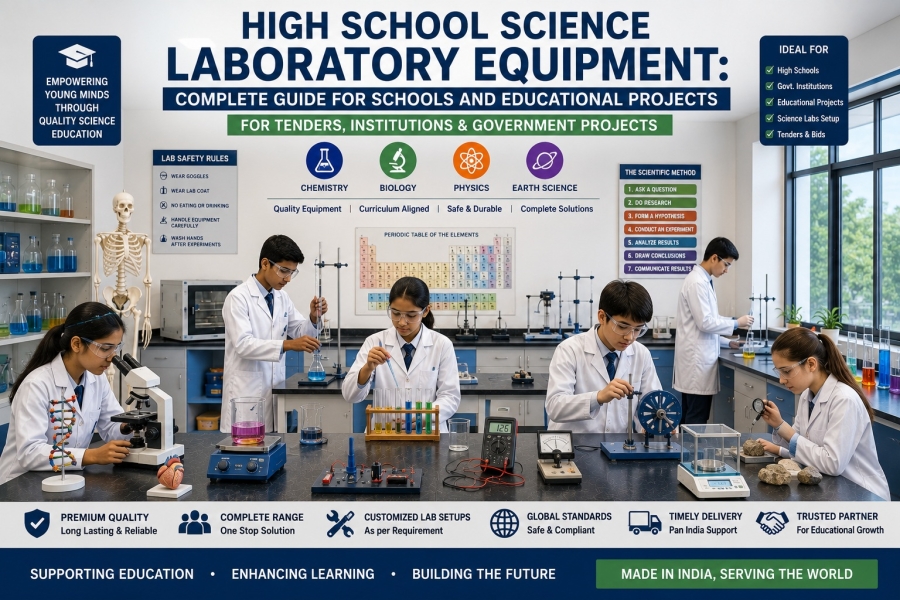
 School Science Lab Instruments
Manufacturers
Bulk Tender
Precision Instruments
Worldwide Export
School Science Lab Instruments
Manufacturers
Bulk Tender
Precision Instruments
Worldwide Export
Setting up a good high school science laboratory is not about filling the room with expensive instruments. A successful school laboratory gives students the opportunity to perform experiments themselves, understand scientific principles through practical work and safely use the equipment prescribed in their curriculum.
A complete high school science laboratory normally includes separate equipment for Physics, Chemistry and Biology, together with common laboratory furniture, storage and safety equipment.
For schools, educational institutions, government projects and international education tenders, the most important consideration is selecting the correct equipment in sufficient quantities and ensuring that it is suitable for the students' academic level.
Naugra Lab Equipments manufactures and supplies a wide range of school laboratory equipment from India for educational institutions, distributors, government procurement projects and international tenders.
The exact laboratory configuration depends on the curriculum, number of students and experiments to be conducted. However, most secondary and high school laboratories require the following categories.
A high school physics laboratory should allow students to physically observe principles of mechanics, electricity, magnetism, optics, heat and measurement.
Commonly required Physics Lab Equipment includes:
The objective should be to provide enough experimental sets for students to work individually or in small groups.
For a school laboratory, this is often more valuable than purchasing a small number of highly sophisticated instruments that students rarely use.
Chemistry laboratories require particularly careful planning because students work with glassware, chemicals, heat and sometimes fumes.
A typical high school chemistry laboratory equipment list includes:
Where laboratory glassware will be subjected to heating or temperature changes, suitable laboratory-grade borosilicate glassware should be selected.
Schools may also require:
Chemical storage also deserves proper attention. Reagents should be clearly labelled and stored according to appropriate laboratory safety procedures.
Biology practical work is based heavily on observation, microscopy, specimens and anatomical study.
The biology laboratory equipment for high schools normally includes:
Microscopes are among the most important pieces of equipment in a biology laboratory. Schools should therefore consider both optical quality and quantity.
Instead of having only one or two microscopes for demonstration, laboratories should ideally have sufficient units for students to perform practical work in manageable groups.
Safety should be planned at the same time as the scientific apparatus rather than being treated as an optional addition to the project.
Depending on the laboratory configuration, schools may require:
Chemistry laboratories in particular should have suitable ventilation and provision for handling fumes generated during practical experiments.
Equipment alone does not make a functional science laboratory.
Schools establishing new laboratories may also require:
The furniture layout should provide adequate working space while allowing teachers to supervise students during practical activities.
There is no single quantity that works for every school.
The requirement depends mainly on:
For commonly performed experiments, purchasing several practical sets is normally better than purchasing one demonstration unit.
For example, if a class contains 30 students, equipment can be planned around practical groups rather than expecting the entire class to share a single apparatus.
This approach makes the laboratory genuinely useful for hands-on science education.
When budgets are limited, procurement should begin with equipment that students will use most frequently.
Safety equipment should receive first priority. This should be followed by essential laboratory glassware, measurement equipment and consumables.
The next priority should be the core apparatus required for curriculum experiments — such as microscopes for Biology, electrical and mechanics equipment for Physics, and glassware and heating apparatus for Chemistry.
Models, charts and additional teaching aids can then be selected according to the curriculum and available budget.
More advanced instruments should generally be considered only after the basic laboratory has been adequately equipped.
A well-planned laboratory containing sufficient quantities of essential equipment is usually more useful to students than a laboratory containing a few impressive but rarely used instruments.
Large educational projects require a different approach from purchasing equipment for an individual school.
Government departments, Ministries of Education, universities, procurement agencies, NGOs, development organisations and educational distributors may need laboratory equipment for dozens or even hundreds of institutions.
Such projects can involve:
For these projects, working with a manufacturer capable of supplying several laboratory categories can considerably simplify procurement.
Naugra Lab Equipments provides laboratory equipment for schools and educational projects across multiple science disciplines.
Rather than requiring a buyer to coordinate separately with different suppliers for Physics, Chemistry and Biology, complete laboratory requirements can be consolidated according to the project's BOQ or curriculum.
Our product range covers:
Physics Laboratory Equipment
Equipment for mechanics, measurement, electricity, magnetism, optics, heat, waves and other curriculum experiments.
Chemistry Laboratory Equipment
Laboratory glassware, heating apparatus, stands, clamps, measuring equipment and general chemistry laboratory accessories.
Biology Laboratory Equipment
Microscopes, slides, dissection equipment, anatomical models, specimens and teaching aids.
General Laboratory Equipment
Laboratory instruments, furniture, storage solutions, safety equipment and supporting accessories.
Naugra Lab Equipments is an educational laboratory equipment manufacturer and exporter from India, supplying equipment for schools, colleges, universities, vocational institutions and educational projects.
International buyers often have requirements that go beyond simply purchasing individual laboratory products. A distributor or tender contractor may receive a BOQ containing hundreds of different items covering several laboratory disciplines.
Our team can evaluate such requirements and assist buyers in identifying suitable equipment against their specifications.
This makes the supply process particularly useful for:
Educational laboratory requirements differ considerably between countries.
A school science project may follow a national curriculum, international curriculum or tender-specific technical specification. For this reason, laboratory equipment should not simply be selected from a standard catalogue without examining the actual requirement.
Naugra Lab Equipments can work from a buyer's:
The equipment can then be reviewed according to the intended educational application.
This is particularly important for international tenders where compliance with the requested specification can be as important as price.
Using one supplier for a substantial portion of an educational project can make purchasing easier.
It can reduce the number of purchase orders, simplify technical coordination and make consolidation for international shipment more manageable.
For distributors and tender contractors, it can also make quotation preparation considerably faster because Physics, Chemistry, Biology and general laboratory requirements can be evaluated together.
The objective is not simply to sell laboratory instruments. It is to help the buyer develop a practical laboratory configuration that corresponds to the students, curriculum and available budget.
A high school science laboratory generally requires Physics, Chemistry and Biology equipment together with safety equipment, laboratory furniture and storage. Typical requirements include measuring instruments, electrical experiment apparatus, optics equipment, laboratory glassware, heating equipment, microscopes, biological models and safety products.
Common requirements include measuring instruments, mechanics apparatus, electrical experiment equipment, magnets, lenses, mirrors, prisms, optical equipment, thermometers and calorimeters. The final selection should correspond to the practical experiments in the school's curriculum.
A chemistry laboratory normally requires laboratory glassware, Bunsen burners or other heating equipment, stands and clamps, measuring equipment, reagents and indicators, storage facilities and appropriate safety equipment.
Important Biology laboratory equipment includes compound microscopes, prepared and blank microscope slides, dissection kits, specimen jars, anatomical models, plant and animal models and biological teaching charts.
Quantities should be calculated according to class size and the number of students expected to perform each experiment together. For frequently conducted practicals, enough equipment should be available for students to work in small groups.
Yes. Educational equipment requirements can be evaluated against a buyer's BOQ or tender specifications so that suitable products can be identified for Physics, Chemistry, Biology and other laboratory categories.
Yes. Naugra Lab Equipments supplies educational laboratory equipment from India for schools, distributors, institutional buyers and international educational projects.
Naugra Lab Equipments works with distributors, contractors and institutional buyers requiring laboratory and educational equipment for government and educational procurement projects.
The best school laboratory is not necessarily the one with the largest number of instruments. It is the one in which students have reliable equipment available when they need to perform an experiment.
Start with safety. Provide adequate quantities of the essential equipment. Match the apparatus to the curriculum. Then add more specialised instruments where the syllabus genuinely requires them.
For international distributors, educational institutions and tender contractors looking for a school laboratory equipment manufacturer in India, Naugra Lab Equipments can provide equipment across Physics, Chemistry, Biology and general laboratory categories for individual institutions as well as larger educational projects.
Send us your BOQ, laboratory equipment list or tender specifications for technical review and quotation.
Talk to our specialists about your laboratory setup or bulk-tender requirements.
