

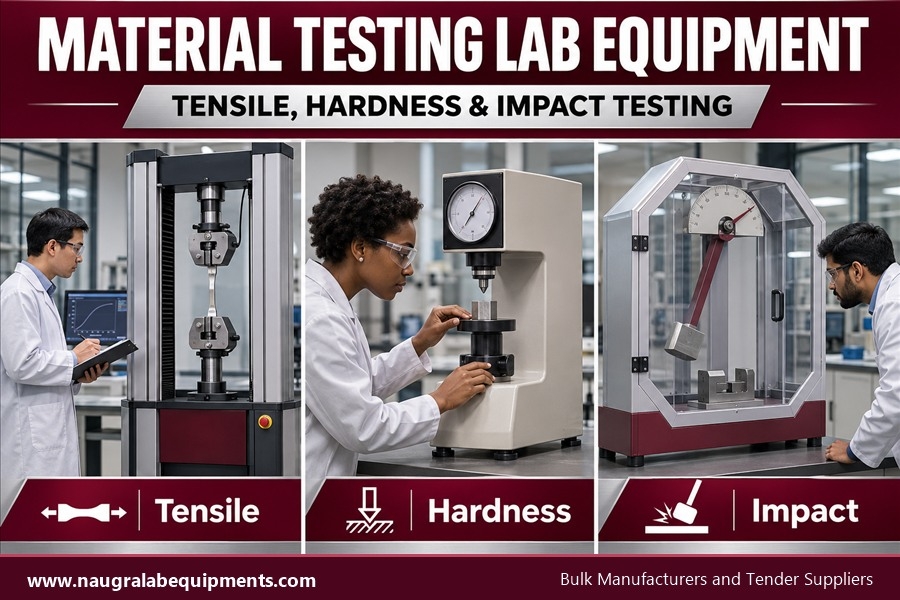
 Precision Testing Lab Machines
Africa Exports
Worldwide Export
Material Testing
Civil Testing
A materials lab is bought once and used for twenty years. The usual mistake is to order by machine name alone: "one universal testing machine". The quote that comes back may be for the wrong capacity, the wrong grips or a readout the lab cannot use. The machine then sits idle while spare parts and adaptors are chased.
Naugra Lab Equipments is a manufacturer and supplier of testing machines and engineering lab equipment in Ambala Cantt, Haryana, India. We supply engineering colleges, polytechnics, industrial labs and tender contractors in Africa.
Start from the tests on your syllabus or quality plan. The machine follows from the test.
| Test | What it measures | Machine | Standards often quoted |
|---|---|---|---|
| Tension | Yield strength, tensile strength, elongation | Computerised Universal Testing Machine or Universal Testing Machine - Tensile Tester | ISO 6892-1, ASTM E8 |
| Compression and bending | Crushing strength, flexural strength | Universal testing machine with platens and bend fixture | Material-specific |
| Rockwell hardness | Resistance to indentation, read directly | Digital Rockwell Hardness Tester | ISO 6508, ASTM E18 |
| Brinell hardness | Indentation hardness of castings and softer metals | Brinell tester with Brinell Indenter | ISO 6506, ASTM E10 |
| Impact | Energy absorbed in sudden fracture | Impact Testing Machine Izod and Charpy | ISO 148-1, ASTM E23 |
| Torsion | Shear modulus and strength in twisting | Digital Torsion Testing Machine | Material-specific |
| Fatigue | Life under repeated loading | Fatigue Testing Machine | Material-specific |
| Creep | Slow deformation under steady load and heat | Creep Testing Machine | Material-specific |
The standard numbers above are the ones most often seen in tenders. Check the edition your institution or client uses and ask the supplier to state which standard each machine is built to.
Capacity decides the price and the foundation. Work out the largest force you will need from the strongest specimen you will test, then add a margin. A machine that is far too large reads small loads poorly.
Next choose the readout. There are three levels:
List the grips and fixtures you need: flat and round specimen grips, compression platens, a bend fixture and a shear attachment. Missing fixtures are the most common reason a new machine cannot run a test. The full range is under universal testing machines and tensile testing machines.
Rockwell is quick and gives a direct reading, so it suits teaching labs and production checks on steel. A Motorised Rockwell System Hardness Tester applies the load the same way each time, which reduces operator error. Brinell uses a larger ball and suits castings and softer metals with a coarse structure. Order test blocks with the machine, so staff can check it daily. See Rockwell testing machines and hardness testing machines.
An impact tester swings a pendulum through a notched specimen. One machine can usually run both Izod and Charpy tests with a change of striker and support. A Digital Impact Test Machine shows the absorbed energy on a display instead of a dial.
Torsion, fatigue and creep machines are for degree-level courses and research. Buy them after the tensile, hardness and impact machines are in use, not before. These are grouped under materials testing lab equipment.
Tender writers should give capacity, readout type, fixtures and the test standard for each machine. This lets evaluators compare bids on equal terms. If a calibration certificate is required, name the standard for it; ISO 7500-1 is the usual one for force verification.
Contractors equipping several polytechnics should order the same model for each site. Staff training and spare parts are then shared. Distributors who brand machines under their own name should agree nameplates and manuals with the order.
Civil engineering buyers can also see steel testing lab equipment. Our earlier post on bulk testing lab machines covers the wider range.
It depends on the specimens. Tell us the material and the largest specimen size on your syllabus and we will suggest a capacity. Do not order the largest machine by default.
Yes. A universal testing machine does all three when it is supplied with the right grips, platens and bend fixture. List the fixtures on the order.
For research and commercial testing, yes, because it records curves and prints reports. For basic teaching, an analog or electronic machine is easier to maintain.
Our catalogue includes these. Send your complete list and we will mark each item we can offer.
Send your test list, specimen sizes and site power details, and we will propose a machine for each test. Email sales@naugralabequipments.com or use the contact page. You can also add items to an enquiry from the product catalogue.
Talk to our specialists about your laboratory setup or bulk-tender requirements.
