

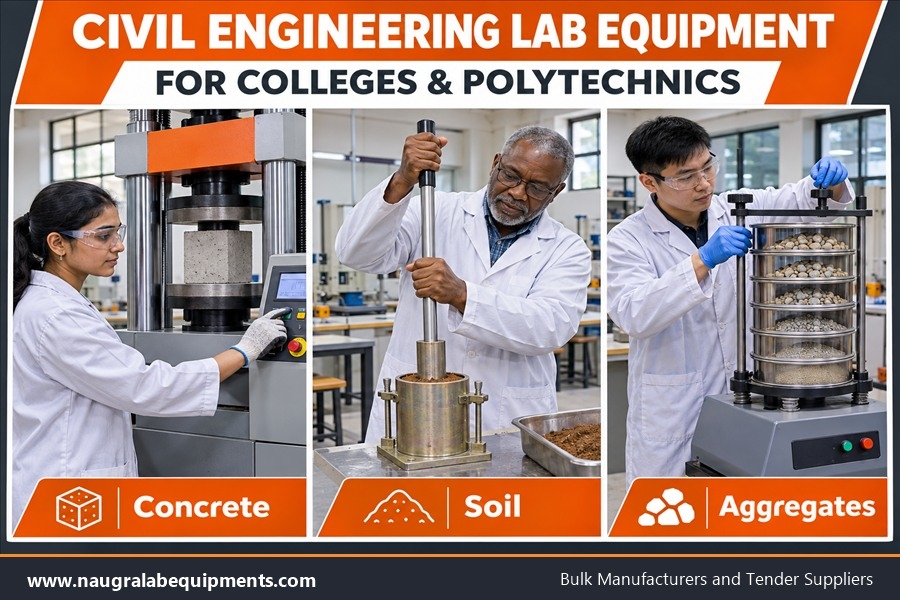
 Civil Engineering Lab Equipment Experts
Civil Testing
Tender Supply
Lab Equipment
Material Testing
A civil engineering department is judged by what its graduates can do on site in their first month: run a compaction test, cast and crush cubes, set out a building line. Departments that buy equipment from a general catalogue often own impressive machines and still cannot run half the practicals on the timetable, because small items and sets for student groups were left out.
Naugra Lab Equipments is a manufacturer and supplier of civil engineering laboratory equipment in Ambala Cantt, Haryana, India. We supply colleges, polytechnics, tender contractors and distributors across Africa.
Civil engineers design and supervise roads, buildings, bridges, dams and water systems. On every one of those jobs, somebody must decide whether the ground will carry the load, whether the concrete is strong enough and whether the structure is in the right place. The teaching labs map onto those three questions: soil and materials, concrete and structures, and survey.
| Course unit | Practicals students perform | Equipment |
|---|---|---|
| Soil mechanics | Grading, limits, compaction, strength, field density | Soil sieves, Liquid Limit Apparatus, Direct Shear Apparatus, Triaxial Test Set, Core Cutter, Sand Replacement Equipment |
| Foundation and pavement design | Bearing ratio, settlement, permeability | Motorised CBR Machine, Consolidation Apparatus, Soil Permeability Apparatus |
| Concrete technology | Workability, casting, curing, crushing | Slump Test Apparatus, Vee Bee Consistometer, cube moulds, Compression Testing Machine |
| Cement | Consistency, setting time, soundness | Vicat Apparatus and related cement apparatus |
| Aggregates | Impact, crushing, abrasion, grading | Aggregate Impact Tester With Blow Counter, Aggregate Crushing Value Apparatus, Los Angeles Abrasion Testing Machine, sieve shaker |
| Surveying | Levelling, angles, setting out, mapping | Electronic Theodolite, Total Station, levels, staves, tapes, ranging rods |
| Hydraulics | Flow measurement, losses, open channels | Hydraulic bench with accessories |
| Strength of materials | Tension, bending, hardness | Universal testing machine |
Sections of the catalogue: soil testing, concrete testing, cement testing, aggregate testing, survey instruments and bitumen and asphalt testing.
Split the list into two kinds of item.
Most shortfalls are in the first kind. A department with one slump cone cannot run a concrete practical for thirty students in a two-hour slot.
Add these to every list: balances in two capacities, a drying oven, moisture tins, trays, scoops, spatulas, straight edges, measuring cylinders, a curing tank, tamping rods, stopwatches and thermometers. They are cheap, they are always needed, and they are the first things missing from a tender.
Polytechnic diploma courses stress routine site tests: grading, compaction, slump, cube strength, levelling. Degree courses add triaxial, consolidation, permeability and mix design. Research and consultancy work adds automatic data logging and larger capacities. Buy for the level you teach now, and leave floor space and power points for the next level.
Tenders in English-speaking Africa commonly quote British and European standards, with ASTM as an alternative: BS 1377 for soil tests, the EN 12390 series for hardened concrete, EN 196 for cement, and BS 812 or EN 1097 for aggregates. Check which edition your accrediting body or road authority uses, and ask each bidder to state the standard every item is built to. A mould or sieve made to a different standard is not interchangeable.
Write one lot per laboratory: soils, concrete and cement, aggregates, survey, hydraulics. Each can then be evaluated by the lecturer in charge and awarded separately if needed.
Contractors equipping several polytechnics under one project should fix a standard list per laboratory and multiply it. Mixed lists per site are where shortages and disputes start. Ask the supplier to pack by laboratory and by site, with packing lists that follow the tender line numbers.
Distributors can supply the same range under their own brand, and stock consumables that colleges reorder each year: sieves, cube moulds, moulds for compaction, and glassware.
Related posts: concrete testing lab kit for engineering colleges, bitumen and asphalt testing equipment and material testing lab equipment.
Soil mechanics, concrete and cement, aggregates and highway materials, surveying, hydraulics and strength of materials are the core teaching labs.
Plan one set of hand apparatus for every four or five students. Large machines are shared by the whole class.
Quote the standards your accrediting body uses. BS 1377, EN 12390 and EN 196 are common, with ASTM equivalents. Ask bidders to state what each item conforms to.
Yes. Send the list of practicals or your tender schedule and we will quote lab by lab, marking any item we cannot offer.
Tell us the site and the machines involved. We will state in the quotation what installation and training we can provide.
Send your course units, practical list and student numbers, or the tender schedule as issued. Write to sales@naugralabequipments.com or send the details through our contact page.
Talk to our specialists about your laboratory setup or bulk-tender requirements.
