

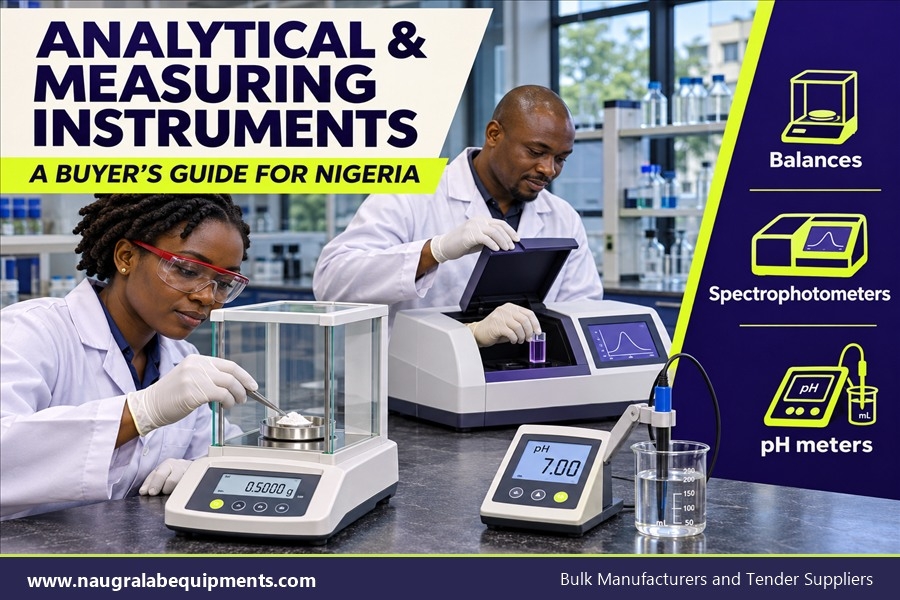
 Accurate Measuring Instruments
Manufacturers
Lab Equipment
Engineering Lab
Civil Testing
Instrument lists in tenders often name the instrument but not the measurement. "Spectrophotometer" could mean a simple visible-range unit for teaching or a double-beam UV-VIS unit for research. The price differs many times over. A list built around what must be measured, and how finely, avoids this.
Naugra Lab Equipments manufactures and supplies laboratory instruments from Ambala Cantt, Haryana, India. We supply universities, polytechnics, industrial labs and tender contractors across Africa, including Nigeria.
| Quantity measured | Instrument | Typical use |
|---|---|---|
| Mass | Analytical Balance | Weighing reagents and samples to fine limits |
| Acidity (pH) | Digital PH Meter | Water, soil, food and titration end points |
| Conductivity and dissolved solids | Digital Conductivity Meter, Digital TDS Meter | Water quality and solution strength |
| Turbidity | Digital Turbidity Meter | Clarity of drinking water and effluent |
| Light absorbance | Naugra Lab Digital Photoelectric Colorimeter, Microprocessor Spectrophotometer, Naugra Lab Double Beam UV-VIS Spectrophotometer | Concentration of coloured or UV-absorbing substances |
| Sodium, potassium, calcium | Flame Photometer | Soil, water and clinical samples |
| Water content | Auto Karl Fischer Titrimeter | Moisture in oils, solvents and drugs |
| Optical rotation | Naugra Lab Research Polarimeter | Sugars and optically active compounds |
| Melting point | Melting Point Apparatus | Identity and purity of solids |
| Viscosity | Red Wood Viscometer | Oils and fuels |
| Heat of combustion | Bomb Calorimeter | Fuels, feeds and food |
| Frequency and waveform | Frequency Counter, Digital Function Generator, Digital Storage Oscilloscopes | Electronics and physics labs |
| Voltage, current, resistance | Digital Multimeter | Every electrical bench |
pH, conductivity and TDS meters are the first instruments most labs buy. The meter is only as good as its electrode and its calibration. Order spare electrodes and buffer solutions with every meter, and state whether you need bench or portable units. See electrochemistry instruments.
A colorimeter uses filters and suits routine teaching work. A spectrophotometer selects a narrow band of wavelengths and gives finer results. A double-beam UV-VIS unit compares sample and reference at the same time, which helps with stability over long runs. In the specification, state the wavelength range, the bandwidth you can accept and the type of cuvettes. See spectrophotometers and flame photometers.
Melting point, viscosity and calorific value are standard tests in chemistry, petroleum and food courses. They need little power but careful technique. For fuel and oil testing, see oil and petroleum testing instruments.
Frequency is the number of cycles per second, in hertz. Three instruments cover it in a teaching lab. A function generator produces a signal of known frequency. A frequency counter counts cycles over a fixed gate time and shows the value directly. An oscilloscope draws the waveform, so students can measure the period on screen and work out the frequency. Using all three on the same signal is a good first practical, because the readings should agree. See frequency counters and digital storage oscilloscopes.
Nigeria's mains supply is 230 V at 50 Hz, and type G plugs are common. Supply can vary through the day, so plan a voltage stabilizer or UPS for balances, spectrophotometers and other sensitive instruments. Dust and humidity also shorten instrument life; ask for dust covers and store electrodes as the manual says.
The Standards Organisation of Nigeria (SON) runs the SONCAP conformity programme for regulated imports. Since 27 March 2026, SONCAP certificates are activated on Nigeria's National Single Window for Form M and clearance. Main sea ports are Lagos (Apapa, Tin Can Island, Lekki) and Onne. Small instrument orders often travel by air. Confirm the rules for your goods with a licensed clearing agent before shipment, because requirements change.
Tertiary institutions often buy through funded projects with fixed lists. If your list was written some years ago, check that models are still current before you tender.
Tender officers can attach the table above to a schedule and add range and accuracy for each line. Bidders then quote like for like.
Contractors supplying several faculties should group instruments by department, with consumables and spares listed under each. Distributors can order instruments with their own brand on the front panel and manual, and carry electrodes, lamps and cuvettes as stock items.
Related reading: measuring instruments and research lab equipment. Balances are under lab balances.
A colorimeter uses coloured filters to select light and suits routine tests. A spectrophotometer selects a narrow wavelength band and gives finer, more flexible measurements.
With a frequency counter for a direct reading, or with an oscilloscope by measuring the period of the waveform. A function generator provides the test signal.
We recommend one for balances, spectrophotometers and other sensitive instruments, because supply voltage can vary.
Send your complete list. We will mark what we manufacture, what we can source and what we cannot offer.
Tell us which instruments need a certificate and the standard your institution requires, and we will state what we can provide with the quotation.
Send your instrument list with the range and accuracy you need for each line. Email sales@naugralabequipments.com or use the contact page. You can also add items to an enquiry from the product catalogue.
Talk to our specialists about your laboratory setup or bulk-tender requirements.
