

 Bulk Tender Supply Across 50+ Countries
Suppliers India
Bulk Tender
Civil Testing
Africa Exports
A tender line that says "Beaker - 200 pieces" will get five different prices for five different products. One bidder quotes 50 ml soda glass, another quotes 500 ml borosilicate. The cheapest wins, and the school receives beakers that crack on the first burner. The fault is in the line, not the bidder.
Naugra Lab Equipments manufactures and supplies laboratory apparatus from Ambala Cantt, Haryana, India, for tender, bulk and own-brand orders across Africa. This page is written for the people who draft and evaluate those tenders.
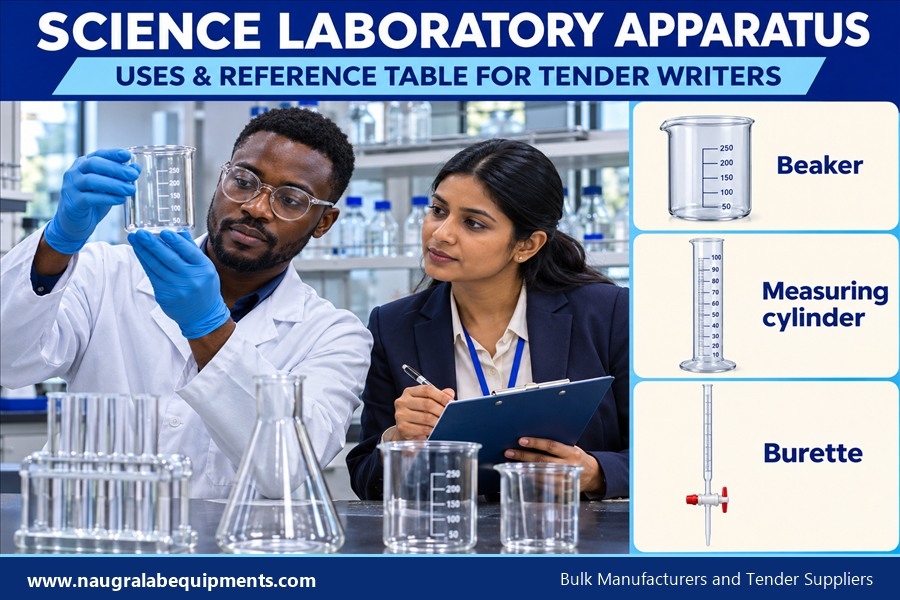
| Apparatus | Used for | State in the tender line |
|---|---|---|
| Beakers | Holding, mixing and heating liquids | Capacity, glass type, low or tall form |
| Conical flask | Titration and swirling without spills | Capacity, neck type, glass type |
| Test tubes | Small reactions and heating | Diameter and length, rimmed or plain, glass type |
| Burette | Delivering a measured volume in titration | Capacity, graduation, stopcock material, accuracy class |
| Graduated pipette | Transferring a set volume | Capacity, class A or B, glass type |
| Pipette Pump | Safe filling of pipettes | Pipette size it fits |
| Measuring cylinder | Measuring volume of liquids | Capacity, glass or plastic, base type |
| Filter funnel | Filtering and pouring | Diameter, stem length, material |
| Buchner flask | Filtering under suction | Capacity, side-arm type |
| Condenser | Cooling vapour in distillation and reflux | Type, effective length, joint size |
| Watch glass | Covering beakers, evaporating small samples | Diameter |
| Petri Dish | Culturing microbes, holding specimens | Diameter, glass or plastic |
| Mortar and pestle | Grinding solids | Diameter, porcelain or other material |
| Desiccator | Keeping samples dry | Diameter, plain or vacuum type |
| Bunsen burner | Heating with gas | Gas type (LPG or natural gas), with or without stopcock |
| Tripod, gauze, clamp and stand | Supporting apparatus during heating | Height, rod length, base size, material |
| Thermometer | Measuring temperature | Range, division, type (liquid-in-glass, digital or infrared) |
| Balance | Weighing | Capacity, readability, power supply |
| Hot plate and stirrer | Heating and mixing without a flame | Plate size, stirring volume, voltage |
| Centrifuge | Separating solids from liquids | Number and size of tubes, speed, voltage |
| pH meter | Measuring acidity | Range, resolution, bench or pocket, electrode included |
| Microscope | Viewing cells and small specimens | Objectives, eyepiece, light source, power |
| Spring Balance | Measuring force and weight | Range in newtons and grams, division |
| Multimeter | Measuring voltage, current and resistance | Ranges, display, fuse protection |
The full ranges are under laboratory glassware, porcelain ware, laboratory metal ware and school lab equipment and instruments.
Two kinds of glass are common in school apparatus. Borosilicate glass resists heat and sudden temperature change. Soda glass is cheaper and suits items that are never heated, such as watch glasses and some pipettes. If a tender is silent on glass type, expect the cheaper one. State borosilicate for beakers, flasks, test tubes for heating, and condensers. Many tenders quote ISO 3585 for borosilicate glass; ask bidders to state what their glass conforms to.
Burettes, pipettes and volumetric flasks come in class A and class B. Class A has tighter limits and suits colleges and examination titrations. Class B is adequate for junior classes and costs less. Decide by level, and write the class in the line. See pipettes, volumetric flasks and measuring cylinders.
Plastic measuring cylinders, beakers and wash bottles do not break and are safer for younger students. They cannot be heated over a flame and some solvents attack them. A sensible school list uses plastic for measuring and storage, and glass for heating. See lab plasticware.
For any item with a plug, state the mains voltage, frequency and plug type of your country. Add the words "with power cord and plug fitted". For instruments, ask for the manual in the working language of your teachers and for any calibration items, such as buffer solutions for pH meters.
Group lines by type: glassware, plasticware, metal ware and supports, heating, measuring instruments, optical, safety. Bidders who specialise can then quote a lot in full, and evaluators can compare totals lot by lot. A single lot with 400 mixed lines favours whoever leaves the most items out.
Ask for a compliance column in every bid: "complies", "deviates" or "not offered" against each line, with the deviation written out. It turns a week of evaluation into a day.
Contractors can send us a draft schedule before they bid. We return it with the missing details marked, so questions go to the buyer during the clarification period, not after award. Distributors building a private-label range can use the table above as a starting catalogue; we supply the items with their brand and item codes on each pack.
Related reading: school science lab supplies tender list and laboratory glassware.
Beakers, conical flasks, test tubes, measuring cylinders, burettes, pipettes, funnels, Bunsen burners, tripods, thermometers, balances and microscopes cover most school practicals.
Yes for anything heated: beakers, flasks, boiling tubes and condensers. Soda glass is acceptable for items that are not heated.
Class A measuring ware has tighter accuracy limits than class B. Class A suits colleges and examinations. Class B is adequate for junior classes.
Yes. Send the draft list and we will mark lines where size, material or unit is missing.
Most items are in our catalogue. Send your full list and we will mark anything we cannot offer.
Send your apparatus list in any format, with the number of schools. Write to sales@naugralabequipments.com or send the details through our contact page.
Talk to our specialists about your laboratory setup or bulk-tender requirements.
