

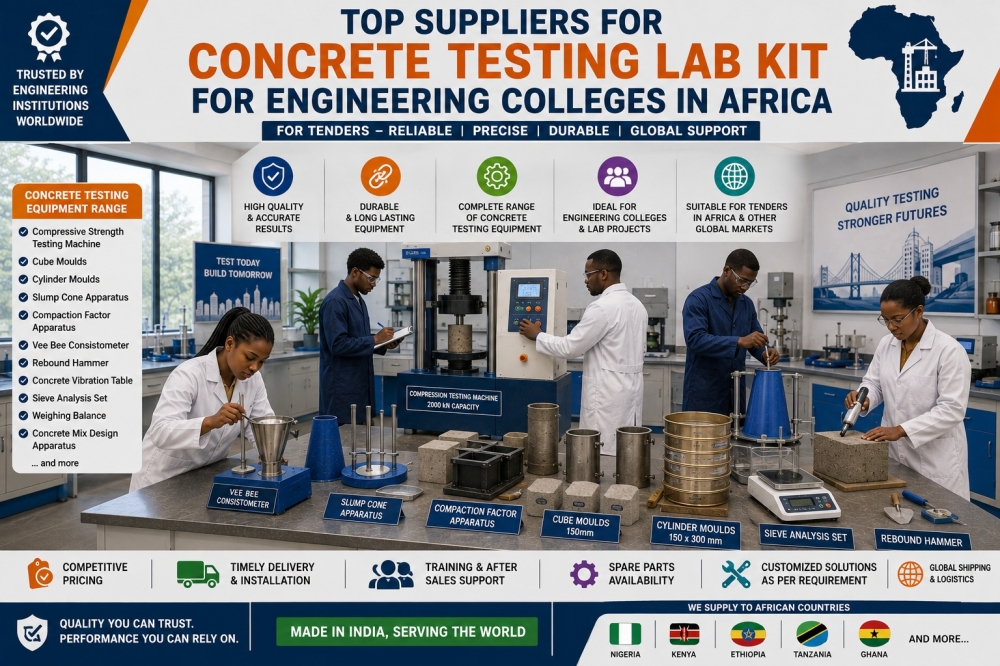
 Concrete & Material Testing Equipment
Worldwide Export
Precision Instruments
Bulk Tender
Civil Testing
Concrete & Material Testing Equipment
Worldwide Export
Precision Instruments
Bulk Tender
Civil Testing
Civil engineering students understand concrete far better when they can actually mix it, test its workability, prepare specimens and measure its strength themselves. For this reason, a properly equipped Concrete Testing Laboratory is an important part of practical training in engineering colleges, universities, polytechnics and technical institutions.
Across Africa, investment in roads, bridges, housing, dams and other infrastructure is also creating greater demand for engineers and technicians with practical materials-testing skills. Educational institutions therefore need laboratory equipment that does more than demonstrate theory — students should be able to perform the same fundamental concrete tests they will encounter in construction and material-testing environments.
Top Suppliers Naugra Lab Equipments manufactures and exports Concrete Testing Lab Equipment from India for engineering colleges, universities, vocational institutions, government education projects and laboratory development projects across Africa.
Complete laboratory packages can be prepared according to an institution's curriculum, BOQ or tender specification.
A concrete testing laboratory is used to study and evaluate the properties of fresh and hardened concrete.
Students can perform practical experiments covering areas such as:
Instead of learning these concepts only from textbooks, students are able to prepare concrete samples, operate testing apparatus, record observations and analyse actual test results.
This practical exposure is particularly valuable for students preparing for careers in civil engineering, construction engineering, materials testing and quality control.
There is no single equipment configuration suitable for every engineering college. Laboratory requirements depend upon the curriculum, number of students, experiments to be performed and available budget.
A typical Concrete Testing Lab Kit for an Engineering College may include the following major equipment.
Concrete cube moulds are used to prepare specimens for compressive-strength testing.
Students learn the complete process of preparing a concrete mix, filling and compacting the mould, curing the specimen and subsequently testing its strength.
Different mould configurations can be supplied according to the laboratory requirement.
The Concrete Slump Test Apparatus is one of the basic pieces of equipment required for studying the workability and consistency of fresh concrete.
It is particularly suitable for student practicals because the experiment clearly demonstrates how changes in a concrete mix influence its behaviour.
A Concrete Compression Testing Machine is used for determining the compressive strength of concrete specimens.
For civil engineering colleges, this is generally one of the major instruments in the concrete laboratory because it allows students to understand the relationship between applied load and concrete strength.
Different capacities and configurations can be considered depending upon the institution's technical specification.
Concrete is not evaluated only by compressive strength.
A Flexural Testing Machine enables students to study the behaviour of concrete specimens under bending loads and understand flexural strength as part of concrete-material testing.
A laboratory concrete mixer allows small batches of concrete to be prepared under controlled laboratory conditions.
Students can change mix proportions and compare how different combinations influence workability and strength.
For educational laboratories, this makes concrete-mix design considerably easier to demonstrate.
A Concrete Vibrating Table assists in compacting freshly prepared concrete specimens.
Students can observe why proper compaction is important and how inadequate compaction can influence the quality and strength of a finished specimen.
The Compacting Factor Apparatus is used for studying the workability of concrete and is particularly useful when examining mixes for which conventional slump testing may provide limited information.
It provides engineering students with another practical method for evaluating fresh concrete.
The Vee Bee Consistometer is commonly used for studying the consistency and workability characteristics of relatively stiff concrete mixes.
Including different workability-testing methods helps students understand why a single test is not necessarily appropriate for every type of concrete.
A Concrete Flow Table can be included where the curriculum requires practical study of concrete flow and workability.
It allows students to observe and measure the behaviour of fresh concrete under controlled laboratory conditions.
An Air Entrainment Meter is used to determine the air content of fresh concrete.
It helps engineering students understand how entrained air can influence the properties and performance of concrete.
A concrete laboratory should bridge the gap between classroom theory and actual engineering practice.
Students may understand the formula for compressive strength academically, but practical laboratory work teaches them considerably more: how a specimen is prepared, why compaction matters, how curing affects results, how testing equipment is operated and how engineering observations are recorded.
A properly planned laboratory can therefore help students develop skills in:
These are skills that students can later apply in construction projects, material-testing laboratories and quality-control departments.
African educational institutions have different requirements depending upon their curriculum and level of study.
A small technical college may require a basic teaching laboratory containing essential concrete-testing apparatus. A university civil engineering department may require a more extensive laboratory covering concrete, cement, aggregates, soil, bitumen and other construction materials.
Naugra Lab Equipments can supply equipment for institutions and educational projects in markets including:
Nigeria | Kenya | Ghana | Tanzania | Ethiopia | Uganda | Rwanda | Zambia | Zimbabwe | Mozambique | Senegal | South Africa and other African countries
Requirements can be evaluated according to the institution's equipment list or tender BOQ rather than forcing every customer to purchase the same standard package.
Large educational procurement projects frequently involve establishing several laboratories or supplying equipment to multiple institutions.
Such projects require more than individual product selection.
Naugra Lab Equipments works with importers, distributors, tender contractors, educational institutions and project suppliers requiring laboratory equipment for government and institutional procurement.
Concrete laboratory requirements can be evaluated against:
This is particularly useful where a tender contains numerous civil engineering laboratory items and the buyer needs to identify suitable equipment against each specification.
Many engineering institutions establishing a concrete laboratory are actually developing a complete Civil Engineering Materials Testing Laboratory.
Depending upon the project, additional equipment may therefore be required for:
Equipment for studying the physical and mechanical properties of cement.
Equipment for determining properties of coarse and fine aggregates used in construction.
Equipment for geotechnical and soil-mechanics experiments required in civil engineering courses.
Testing apparatus for studying bituminous materials and asphalt used in road construction.
Surveying instruments and educational equipment for practical civil engineering training.
By sourcing several laboratory categories together, an engineering college or tender contractor can simplify technical coordination and international shipment.
Buying a laboratory as a package does not mean purchasing every available concrete-testing instrument.
The correct starting point should be the experiments students are actually expected to perform.
For example, a basic undergraduate laboratory may concentrate on concrete mixing, slump, compaction and strength testing. A more advanced university laboratory may require additional instruments for detailed material evaluation.
Before finalising equipment, institutions should consider:
This approach produces a more useful laboratory and avoids spending the budget on instruments that students rarely use.
Naugra Lab Equipments is a manufacturer and exporter of civil engineering laboratory equipment from India, supplying educational and testing equipment for international markets.
Our concrete laboratory range can be supplied as individual instruments or combined into a laboratory package according to project requirements.
We cater particularly to:
For overseas projects, equipment can be consolidated with other civil engineering laboratory requirements to simplify procurement.
For an African distributor, engineering institution or project contractor, sourcing an entire laboratory internationally can become complicated when every instrument comes from a different manufacturer.
Working with a broader Civil Engineering Laboratory Equipment Manufacturer in India can simplify the process.
Concrete, cement, aggregate, soil and bitumen laboratory equipment can be evaluated together, allowing the buyer to coordinate a larger portion of the laboratory requirement through one source.
This becomes particularly useful for government tenders and educational projects in Africa, where a single BOQ may contain dozens or hundreds of laboratory items.
A concrete testing laboratory may include concrete cube moulds, slump test apparatus, compression testing machines, flexural testing equipment, concrete mixers, vibrating tables, compacting factor apparatus, Vee Bee consistometers, flow tables and air entrainment meters. The final equipment list should correspond to the experiments required by the institution.
For basic teaching laboratories, concrete mixing, specimen preparation, workability testing, compaction and compressive-strength testing equipment normally form the core of practical training.
Yes. Naugra Lab Equipments can prepare a laboratory equipment package based on the college's curriculum, required experiments, number of students, BOQ or tender specifications.
Naugra Lab Equipments exports civil engineering and concrete laboratory equipment from India for educational institutions, distributors and project suppliers serving African markets.
Yes. Buyers can submit their tender BOQ or technical specifications for equipment evaluation and quotation.
Yes. Equipment from multiple civil engineering laboratory categories can be consolidated according to the project requirement.
Start with the curriculum and list the practical experiments students must perform. Equipment quantities can then be planned according to class size, student groups, available budget and laboratory capacity.
Whether you are establishing a new Civil Engineering Laboratory, upgrading an existing concrete lab or preparing an equipment proposal for an African government or educational tender, the equipment should begin with the actual technical requirement.
Naugra Lab Equipments can evaluate your equipment list, BOQ or tender specifications and help identify suitable concrete and civil engineering laboratory equipment for the project.
Talk to our specialists about your laboratory setup or bulk-tender requirements.
