

 Quality Lab Equipment Manufacturer & Supplier
Material Testing
Precision Instruments
Worldwide Export
Engineering Lab
Optics is the part of physics that most needs a room of its own. Lasers need safe beam paths, spectrometers need darkness, fibre optic trainers need clean benches, and telescopes need a roof or a field and a clear night. Colleges that squeeze optics into a general physics lab usually end up doing it as a demonstration.
Naugra Lab Equipments manufactures and supplies physics, optics and electronics teaching equipment from Ambala Cantt, Haryana, India. We supply colleges, universities, project contractors and distributors across Africa.
| Area | What students learn | Equipment |
|---|---|---|
| Geometric optics | Lenses, mirrors, image formation, magnification | Optical bench with holders and screens, lens and mirror sets (light and waves kit) |
| Dispersion and spectra | Refractive index, prism, grating, line spectra | Spectrometer, double vernier spectrometer, prism, diffraction grating, sodium and mercury lamps |
| Interference and diffraction | Wavelength from fringes; single and double slit | Laser source, slits, Newton's rings set, travelling microscope |
| Polarisation | Polarised light, optical activity | Polarimeter, polaroid sheets, Malus's law set |
| Photometry and detectors | Intensity, inverse square law, photocells | Photometer, LDR, photodiode, lux meter |
| Fibre optics | Numerical aperture, losses, analogue and digital links | Fibre optic trainers, Laser Fibre Optic Trainer |
| Optical measurement | Non-contact speed and position | Speed Measurement by Optical Pickup |
| Astronomy | Telescopes, solar system, observation | Astro Telescopes, solar system table, Exploring the Solar System kit with teachers guide |
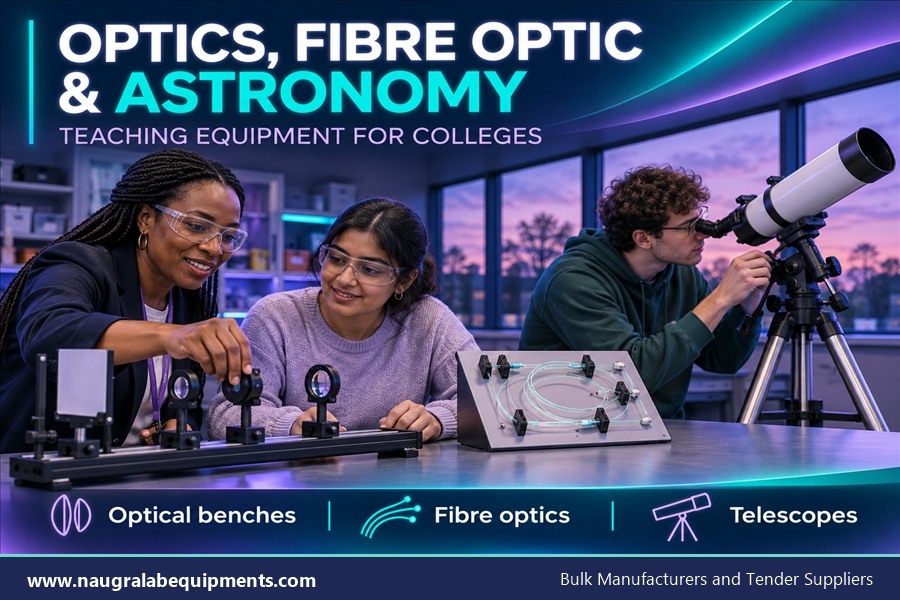
See fibre optic trainers, telescopes, astronomy equipment and spectrometers.
A fibre optic trainer has a light source, a detector and patch fibres on one board, so students can measure numerical aperture, bending and connector losses, and send analogue and digital signals over a fibre link. That covers what physics and electronics courses ask. Splicing and test equipment used by telecom technicians, such as fusion splicers and OTDRs, is a separate, costlier purchase for telecom training centres; send your list if you need it and we will mark what we can supply.
For colleges and teacher training, a small refracting or reflecting telescope with a solar filter, a solar system model, star charts and a planisphere cover most of the syllabus. Observing the Moon, Jupiter's moons and Saturn's rings on one evening does more for interest in physics than any lecture. Never look at the Sun through a telescope without a proper front solar filter.
Lenses, prisms and gratings are damaged by fingerprints, dust and scratches. Handle by the edges, clean only with lens tissue and the right fluid, and keep caps on. Gratings must never be touched on the ruled face. Fibre connectors need dust caps every time they are unplugged. A short care sheet at each bench is cheaper than replacing a grating.
An optics room serves more than physics. Electronics and telecommunication courses use the fibre trainers, chemistry uses the polarimeter and spectrometer for optical activity and spectra, and teacher training colleges use the telescopes and solar system kits. Timetable the room across departments and fund it jointly; it then justifies blackout, stable benches and proper storage.
Colleges: list optics equipment by experiment in the tender, with the light sources stated: a spectrometer without a sodium lamp is unusable. Ask for manuals with sample readings.
Contractors: pack optical parts in their own padded boxes inside the cartons, and supply lamps and their power units together.
Distributors: lens and mirror sets, prisms and solar system kits sell to schools and colleges alike, and can carry your brand. See OEM and contract manufacturing, physics equipment list by topic, STEM lab equipment list for engineering colleges and Electronics Lab Trainers for Kenya.
An optical bench with lenses and mirrors, a spectrometer with prism, grating and lamps, interference and diffraction sets with a laser, a polarimeter, detectors and, for electronics courses, fibre optic trainers.
Numerical aperture, bending and connector losses, and analogue and digital signal transmission over a fibre link.
No. Fusion splicers and OTDRs are telecom tools bought separately. Send your list and we will mark what we can supply.
A small telescope with a front solar filter, a solar system model, star charts and a planisphere cover most teaching needs.
In closed, dust-free cabinets, handled by the edges and cleaned only with lens tissue and suitable fluid.
Send the experiments, level taught and whether the lab can be darkened. Write to sales@naugralabequipments.com or send the details through our contact page.
Talk to our specialists about your laboratory setup or bulk-tender requirements.
